Hero Karizma XMR 250 Spied Undisguised: 30 PS Quarter-Litre Track Weapon
30 PS & 163 kg wet + 249cc DOHC single with gold USD forks and aero winglets + Hero turns its dealer training into an accidental track day debut.

Production-Ready Quarter-Litre Track Weapon Breaks Cover
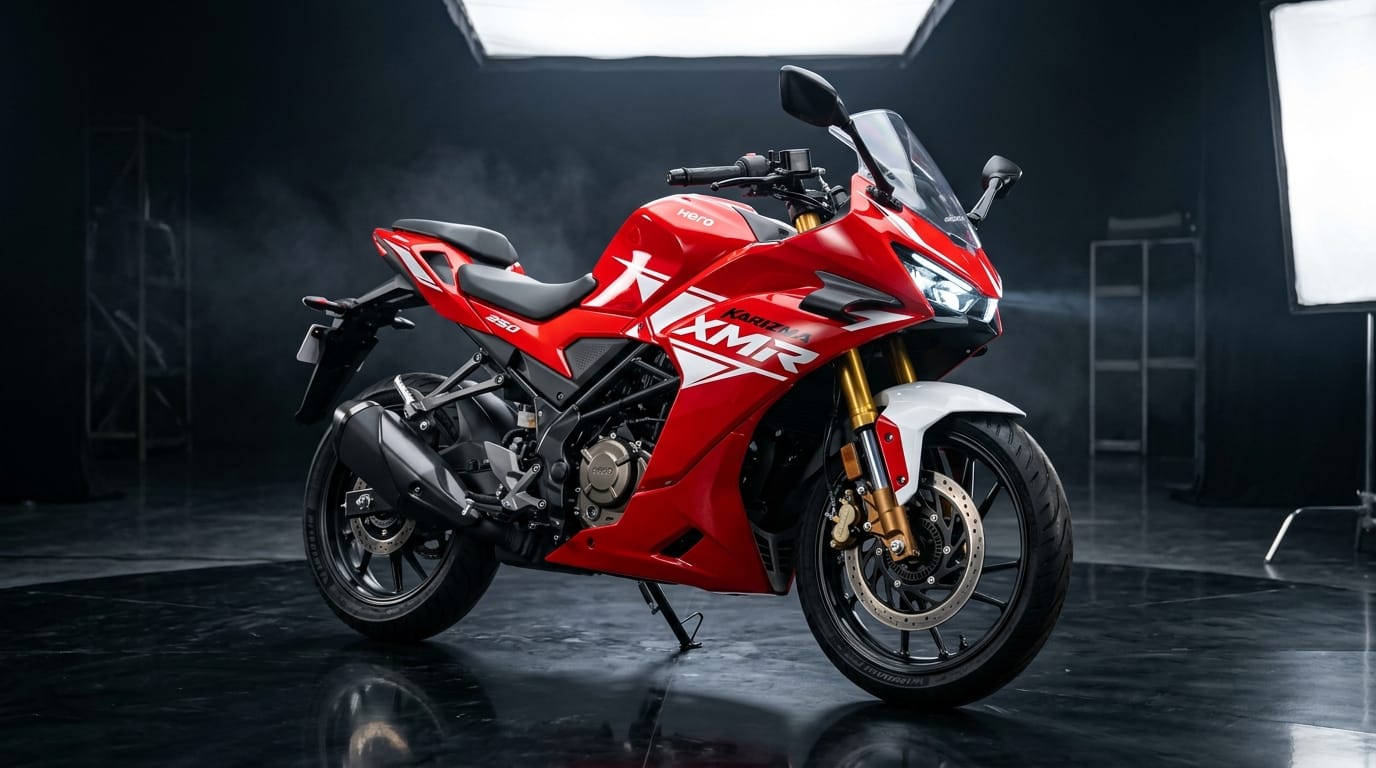
Hero MotoCorp’s aggressive push into higher-displacement performance motorcycling has leaked onto dealership floors in India, where the production-spec Karizma XMR 250 was photographed completely undisguised during dealer sales and technician training meets. Following its initial design showcase at EICMA, the production machine confirms a dedicated lightweight supersport platform powered by a 249cc liquid-cooled DOHC 4-valve single producing an estimated 30 PS (22 kW) at 9,250 rpm and 25 Nm of torque at 7,250 rpm, channelled through a 6-speed gearbox with an assist-and-slipper clutch.
The spy images capture the quarter-litre machine in a vivid single-tone red livery accented by sharp white racing graphics, contrasting black tank recesses, and prominent fairing-mounted aerodynamic downforce winglets. Unlike its commuter-leaning stablemates, the Karizma XMR 250 commits to track-focused chassis architecture: gold-anodised 37 mm upside-down front forks, a rear gas-charged preload-adjustable monoshock, a tubular steel trellis frame, and clip-on handlebars positioned beneath the upper triple clamp.
The move marks Hero’s second major offensive on global-spec machinery in as many weeks, following the official unveil of Hero’s production Xpulse 450 in Milan. While Hero has historically built its empire on utilitarian 100cc commuters and budget air-cooled trail bikes, the XMR 250 directly targets entry-level supersport riders eyeing European A2 track days and Asian quarter-litre cup grids.
Technical Specifications: Karizma XMR 250 vs Benchmark Rivals
The quarter-litre supersport segment remains a fierce proving ground where weight, thermal management, and suspension damping determine whether a small-displacement bike is a genuine track weapon or merely a commuter dressed in race plastic. Here is how Hero’s leaked production numbers stack up against the Suzuki Gixxer SF 250 and CFMoto’s 250SR-R:
| Metric | Hero Karizma XMR 250 (Spied) | Suzuki Gixxer SF 250 | CFMoto 250SR-R |
|---|---|---|---|
| Engine Architecture | 249cc DOHC 4V liquid-cooled single | 249cc SOHC 4V oil-cooled single | 249cc DOHC 4V liquid-cooled single |
| Peak Power | 30.0 PS (22.1 kW) @ 9,250 rpm | 26.5 PS (19.5 kW) @ 9,300 rpm | 29.2 PS (21.5 kW) @ 9,750 rpm |
| Peak Torque | 25.0 Nm @ 7,250 rpm | 22.2 Nm @ 7,300 rpm | 22.5 Nm @ 7,500 rpm |
| Front Suspension | 37 mm Upside-down (USD) fork | 41 mm Conventional telescopic fork | 37 mm Upside-down (USD) fork |
| Front Brake | 300 mm Petal disc, radial caliper | 300 mm Disc, axial caliper | 292 mm Disc, radial caliper |
| Kerb Weight | ~163 kg (est.) | 161 kg | 157 kg |
| Aerodynamics | Integrated downforce winglets | Smooth aerodynamic fairing | Carbon-look track winglets |
| Price Point | ~€2,450 (₹2.20 lakh ex-showroom) | ~€2,250 (₹2.02 lakh ex-showroom) | ~€3,690 (EU MSRP) |
The Rider’s Trade-Off: Track Purity vs Everyday Usability
Opting for the Karizma XMR 250 over standard middleweight nakeds or dual-sports involves a deliberate mechanical and ergonomic compromise. The clip-on handlebars are clamped directly beneath the top yoke, pulling the rider’s torso forward into a dedicated chest-down tuck that loads the wrists under city braking in exchange for front-tire telemetry and high-speed wind deflection.
Furthermore, squeezing 30 PS out of a 249cc single requires a short-stroke bore-and-stroke ratio that thrives above 7,000 rpm. While that provides thrilling punch down the pit straight, low-speed tractability in stop-and-go European city centers will demand active clutch slipping and constant dance across the lower gear cogs compared to a lazier, longer-stroke trail thumper. The upside is genuine chassis rigidity: the cast swingarm pivot plates and steel trellis frame eliminate the mid-corner flex that plagued older Indian-market lightweight sportbikes.
“Quarter-litre supersport engineering has reached the point where aerodynamic winglets and inverted cartridge forks are no longer styling gimmicks—they are functional requirements to keep high-rev singles planted when amateur riders brake deep past the 100-meter marker.”
Cockpit Electronics and Hardware Integration
The leaked dealer training models reveal a fully integrated tech suite that bridges the gap toward larger supersports like the Aprilia RS 660 and KTM 450 RC supersport prototype. Central to the cockpit is a full-color landscape TFT instrument console equipped with Bluetooth connectivity, turn-by-turn navigation, and dedicated track telemetry screens including lap timers, lean angle estimators, and drag split metrics.
Switchgear on the left handlebar cluster reveals dedicated navigation directional toggles, ride-mode selection switches, and an emergency hazard toggle. Dual-channel ABS comes standard, with track software allowing riders to disengage rear ABS intervention for controlled rear-wheel yaw into hairpin apexes.
What We Know
- Powertrain: All-new 249cc liquid-cooled DOHC 4-valve single producing 30 PS and 25 Nm with a 6-speed assist-and-slipper gearbox.
- Chassis & Hardware: Gold 37 mm inverted forks, steel trellis perimeter frame, 17-inch alloy wheels, petal disc brakes with dual-channel ABS, and clip-on bars.
- Aerodynamics: Integrated aerodynamic downforce winglets molded directly into the upper side fairings.
- Electronics: Full-color TFT display featuring Bluetooth pairing, turn-by-turn navigation, lap timer, and switchable ABS modes.
What’s Still Unclear
- European Homologation: Whether Hero will pursue Euro 5+ type approval to export the XMR 250 to EU and UK A2 license holders alongside the Xpulse 450.
- Kerb Weight: The exact production wet mass with a full 11-liter fuel payload remains unconfirmed, though factory sources indicate a target of 163 kg.
- Pricing & Launch Timing: Expected to retail in India between ₹2.10 lakh and ₹2.35 lakh (€2,350 to €2,600), with formal showroom deliveries commencing in early 2027.
Media citation: Editorial outlets and forums may quote excerpts with attribution and a link to Throttle Times.
Reporting via: rushlane.com, bikedekho.com, bikeadvice.in