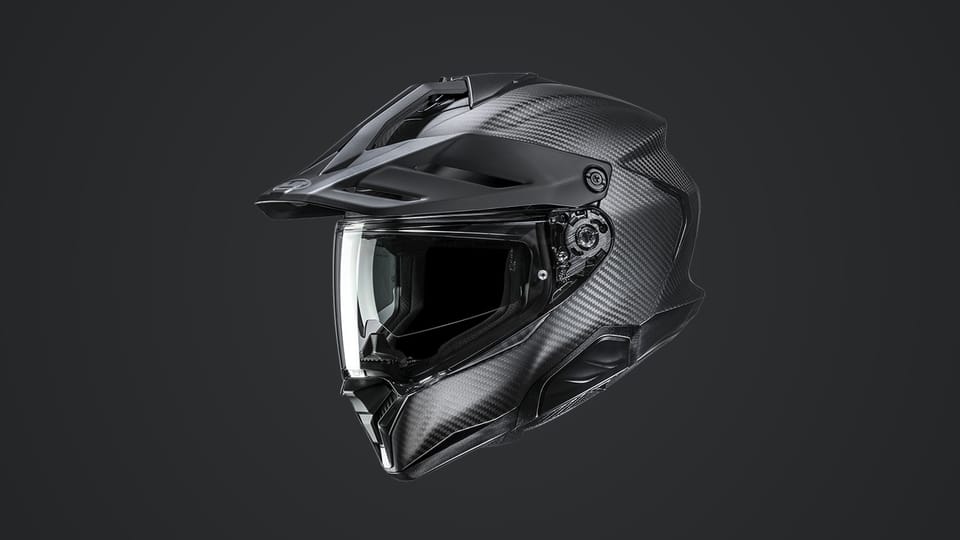
HJC F72 and F72 Carbon Debut: 10% Smaller Shell and Center-Lock HJ-52 Shield
-10% shell volume & 1,350g carbon weave + Center-locking HJ-52 shield kills off-center whistle + HJC overhauls its middleweight benchmark from €319.90.

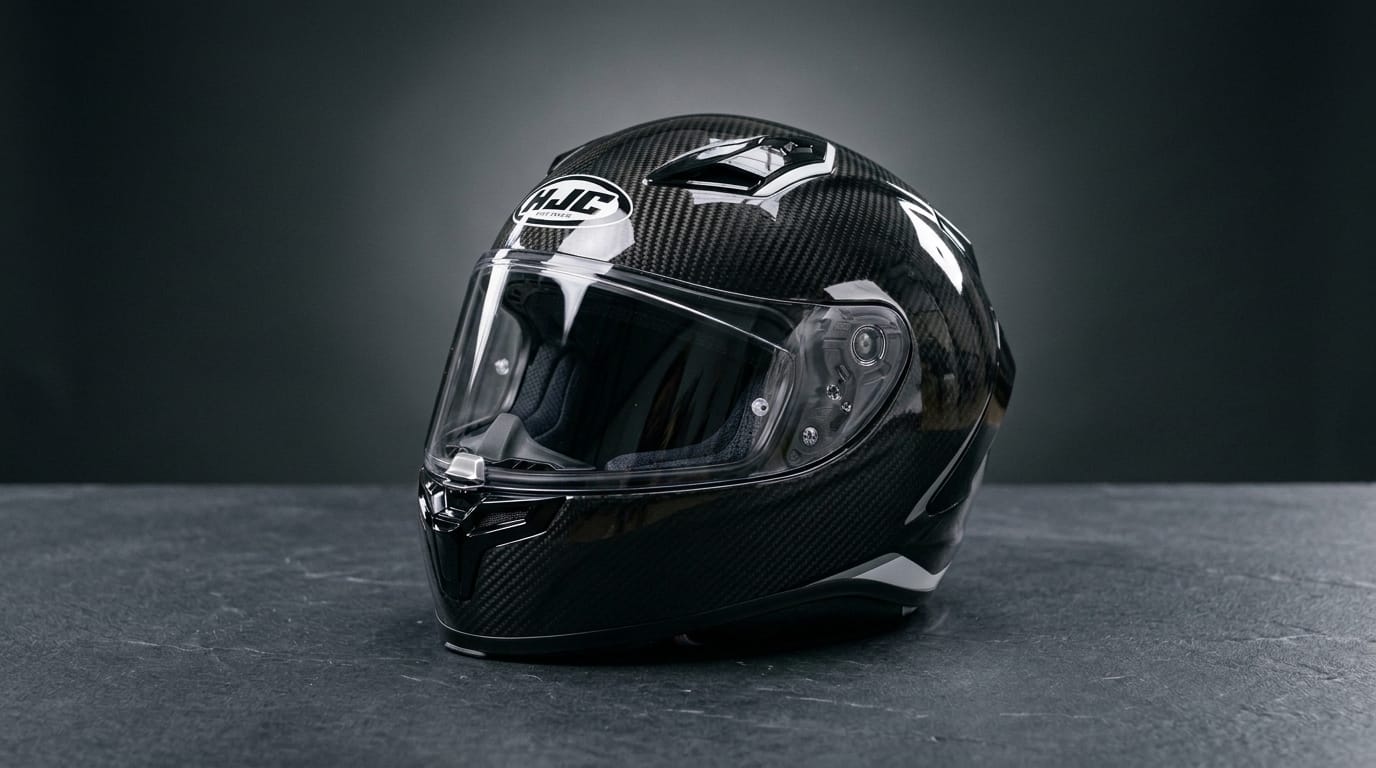
The middleweight sport-touring helmet segment lives or dies on compromise. Riders want race-grade carbon fiber weight without track-day neck cramps, quiet touring aerodynamics without claustrophobic fogging, and an integrated drop-down sun visor without a bulbous bowling-ball shell. With the official European unveiling of the HJC F72 and F72 Carbon, the Korean manufacturer has addressed the biggest mechanical flaws of the outgoing F71 platform, slicing 10% off the exterior shell volume while introducing a completely re-engineered center-locking shield mechanism.
Priced from €319.90 for the Advanced Fiberglass Composite F72 and €429.90 for the full-carbon F72 Carbon, the new lid slots neatly beneath the flagship HJC RPHA 60 Carbon adventure lid and the track-honed RPHA 1 series, taking direct aim at European touring benchmarks like the Shoei NXR 3.
Slicing 10% of the Shell: 1,350 Grams and Real Wind Tunnel Gains
The HJC F72 Carbon registers an official declared weight of 1,352 grams (±50g in size Medium), shedding roughly 80 grams compared to the fiberglass base model and shaving considerable mass from the outgoing F71. To achieve this without compromising penetration resistance under strict ECE 22.06 testing, HJC re-sculpted the multi-piece CAD-designed outer shell across three dedicated shell molds (XS-S, M-L, XL-2XL) paired with four distinct EPS densities.
By pulling the outer perimeter inward by nearly 10% compared to the F71, HJC’s aerodynamicists significantly reduced frontal area. In high-speed highway testing, this reduction cuts aerodynamic lift and lateral buffeting when checking blind spots at 130 km/h on the autobahn. The Advanced Channeling Ventilation System (ACS) features two top ram-air intakes and a multi-stage chin vent, funneling air through deep EPS EPS EPS internal grooves out through dual negative-pressure rear exhaust extractors.
“Our priority with the F72 was eliminating the boundary layer turbulence that plagued previous sport-touring shells,” notes HJC Europe’s technical engineering briefing. “By tightening the outer dimensions and centering the visor retention latch, we achieved a substantially cleaner airflow detachment at speed.”
Center-Lock HJ-52 Shield Kills the Off-Center Whistle
The most welcome mechanical overhaul on the F72 is the complete elimination of the F71’s side-mounted visor latch. On the previous helmet, the offset latch frequently caused the left side of the shield to compress against the rubber gasket tighter than the right, inducing an irritating high-frequency whistle at touring speeds.
The F72 introduces the all-new Optical Class 1 HJ-52 visor, operated via a spring-loaded central release latch positioned directly on the chin bar. Pressing the central tab unlocks the shield, while pulling it down engages an audible two-stage cam lock that pulls the visor uniformly against an updated double-lip perimeter seal. A Pinlock MaxVision 70 anti-fog lens is included in the box. Behind the main shield sits the Dynamic Multi-Step Sunshield, featuring a revised cable-actuated side lever that allows riders to set three distinct drop heights to accommodate different nose bridges.
| Feature / Metric | HJC F72 Carbon | HJC F71 Carbon (Predecessor) | Scorpion EXO-1400 EVO Carbon |
|---|---|---|---|
| Shell Material | 100% 3K Carbon Weave | Carbon-Aramid Hybrid | Ultra-TCT Carbon Composite |
| ECE Homologation | ECE 22.06 | ECE 22.06 | ECE 22.06 |
| Weight (Medium) | 1,352g (±50g) | 1,440g (±50g) | 1,380g (±50g) |
| Visor Mechanism | Center-Lock HJ-52 (Class 1) | Offset Side-Lock HJ-38 | Ellip-Tec II Center Cam |
| Internal Sun Visor | Dynamic 3-Position Multi-Step | 2-Position Slider | Speedview Drop-Down |
| Shell Sizes | 3 Shells / 4 EPS | 3 Shells / 3 EPS | 3 Shells / 3 EPS |
| Base Price (EUR) | €429.90 (Solid Carbon) | €399.90 (Outgoing) | €419.90 |
The Rider’s Trade-Off: Aerodynamic Compactness vs Acoustic Isolation
The trade-off on the F72 Carbon centers on shell volume versus low-frequency drone. By trimming 10% of the exterior dimensions to keep the helmet nimble and light, HJC reduced the internal air pocket volume around the ear cavities. While the chin curtain and revised 3D neck roll do an exceptional job suppressing direct wind buffeting, riders aboard upright adventure motorcycles with mid-height touring screens may experience concentrated low-frequency engine drone channeled up through the base collar.
Furthermore, while the 1,352-gram carbon construction is a blessing during ten-hour alpine touring days, the ultra-stiff carbon weave transmits high-frequency road vibrations more directly than the fiberglass variant. Riders prioritizing absolute silence over absolute lightness may find the standard €319.90 fiberglass F72 slightly plusher on all-day highway hauls, while sport riders and naked-bike pilots will relish the Carbon’s agility.
The interior is lined with HJC’s quick-drying, antibacterial fabric, fully removable and washable with interchangeable cheek pads across shell sizes. An emergency quick-release pull-tab system allows paramedics to remove cheek pads without cervical deflection. The helmet secures with a stainless Double-D ring chin strap and features integrated recess pockets tailored for second-generation SMART HJC Bluetooth communication systems.
The HJC F72 and F72 Carbon arrive at authorized European motorcycle dealerships in late 2026, with solid carbon finishes starting at €429.90 and detailed graphic editions (including the Kairo and Eos schemes) retailing at €479.90.
Media citation: Editorial outlets and forums may quote excerpts with attribution and a link to Throttle Times.
Official product page: https://hjchelmets.eu/
Reporting via: motogeareurope.com, sportsbikeshop.co.uk