Piaggio Patents Active Aerodynamic Flaps for Future Aprilia and Moto Guzzi Bikes
US 12,780,342 & 2 motorized side flaps + Hinged fairing panels deploy above center of gravity + Piaggio takes the V100 Mandello's aero wings into the superbike arena.

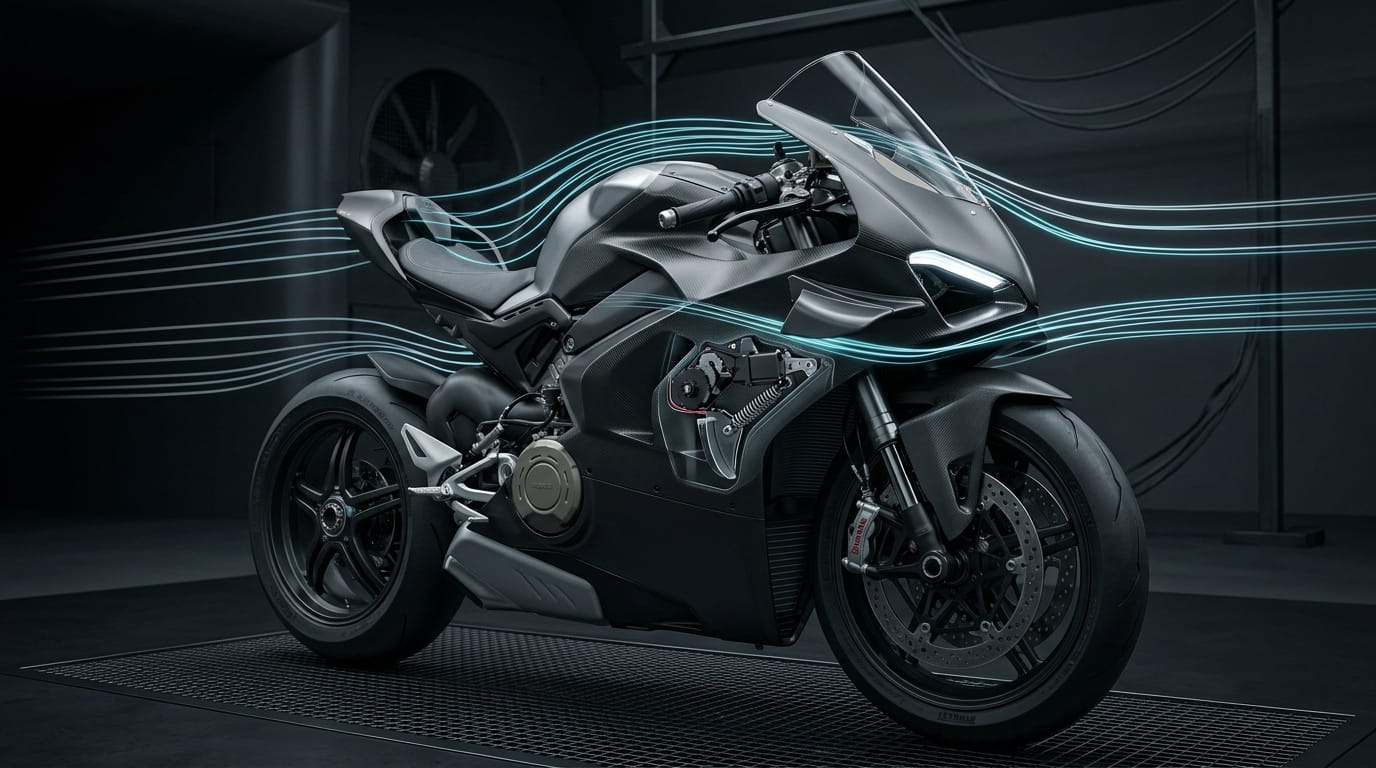
Piaggio & C. S.p.A. has been officially granted United States Patent No. 12,780,342 for an active motorcycle aerodynamic system, detailing motorized fairing flaps that deploy dynamically from flush-fitting pockets on the fuel tank and upper fairing flanks. Filed by Piaggio Group Head of Design Marco Lambri and lead aerodynamicist Francesco Marchetta, the architecture is engineered to provide variable downforce and rider weather protection without the drag penalties of static winglets.
While fixed biplane wings have become the standard cosmetic and aerodynamic flourish on modern superbikes, their permanent drag signature punishes top-end acceleration on straights and catches violent side gusts. Piaggio’s patent represents a sophisticated evolution of the active winglets first seen on the Moto Guzzi V100 Mandello, scaled up for high-velocity sport and touring platforms.
What the Patent Claims: Motorized Pockets Above the Center of Gravity
United States Patent 12,780,342, issued on November 3, 2026, claims a motorcycle fairing comprising movable aerodynamic portions positioned on the left and right sides of the vehicle, located entirely above the machine’s center of gravity. In their rest position, these aerodynamic panels sit completely flush inside recessed pockets moulded directly into the outer fairing skin, preserving a laminar, low-drag boundary layer along the tank.
When triggered by the onboard six-axis Inertial Measurement Unit (IMU), electronic control unit, or specific rider modes, dedicated electric servo-actuators rotate the flaps along a forward-inclined axis of rotation. The trailing edge of each flap swings laterally outward into the oncoming airstream, creating an adjustable aerodynamic channel between the inner pocket wall and the deflector. Under heavy braking, both flaps deploy to maximum extension, increasing frontal surface area to act as an aerodynamic airbrake while shifting aerodynamic load forward to suppress rear-wheel lift. In high-speed cornering transitions, the flaps can articulate independently, trimming crosswind turbulence and stabilising the chassis roll axis.
“The movable portion of the fairing moves dynamically between a rest position, in which it is housed inside a pocket formed in the fairing wall, and an open position, in which its rear edge detaches laterally from the wall to generate localized aerodynamic forces and direct airflow away from the rider,” notes the patent specification.
The Rider’s Trade-Off: Active Ground Effect vs Real-World Servos
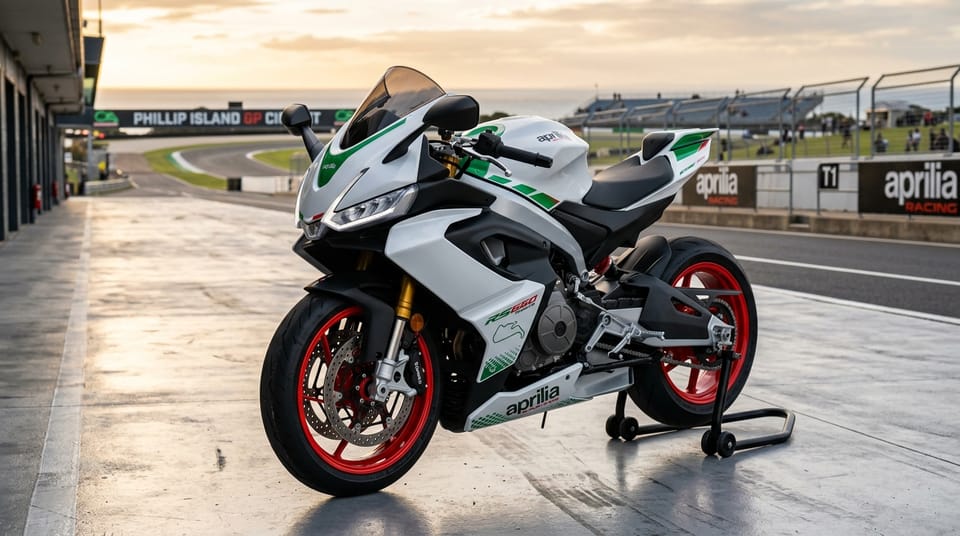
The engineering appeal of active aerodynamics is the elimination of drag on straights paired with targeted downforce under braking. Fixed aerodynamic packages, like the radical carbon appendages on the Aprilia RSV4 Obscure Spe.Ed, generate impressive front-end stability through 200 km/h sweepers but act as permanent parachutes down long straights and add noticeable steering inertia during rapid direction changes.
The trade-off, however, lies in mechanical vulnerability and unsprung-adjacent mass. Housing stepper motors, linkages, pivot pins, and wiring harnesses inside the upper fairing flanks adds between 1.2 kg and 1.8 kg high up on the chassis—precisely where racers fight to shave grams. Furthermore, mechanical hinges operating in high-speed airflow are vulnerable to grit, insect build-up, and front-wheel roost. If a servo fails or a stone jams a hinge at 220 km/h, asymmetrical aerodynamic drag across the steering axis could create violent yaw instability before the rider can react.
Technical Comparison: Aerodynamic Implementations
| Specification | Piaggio US 12,780,342 (Active Aero) | Moto Guzzi V100 Mandello (Production) | Aprilia RSV4 Obscure Spe.Ed (Static) |
|---|---|---|---|
| Aero Architecture | Dynamic flush-pocket motorized flaps | Dual speed-sensitive tank winglets | Fixed multi-tier biplane carbon wings |
| Actuation Method | Electronic servo with variable angle | Electric worm-drive actuators | Fully static / non-movable |
| Primary Objective | Variable downforce & airbrake deceleration | High-speed rider wind protection | Maximum front-end track downforce |
| Mounting Location | Upper fairing flanks above center of gravity | Upper tank fairing forward of rider knees | Front fairing nose and lower fairing flanks |
| IMU Integration | Full 6-axis IMU & brake pressure feedback | Speed and riding-mode dependent | None (passive aerodynamic load) |
| Drag Penalty | Zero drag in retracted rest position | Moderate drag when deployed | Continuous drag penalty across all speeds |
| Weight Penalty | ~1.5 kg (estimated motors & linkages) | ~1.1 kg (actuators and hardware) | Negligible (<300 g carbon fibre) |
With Aprilia’s racing department celebrating landmark Grand Prix breakthroughs like when Bezzecchi Dominates Qatar GP to Hand Aprilia Historic First Lusail Win, Piaggio’s Noale engineers have accumulated world-class aerodynamic data. Translating active aero into production machinery provides a bridge between Grand Prix wind-tunnel research and real-world European road riding.
What We Know / What’s Still Unclear
What We Know: - U.S. Patent 12,780,342 was officially granted to Piaggio & C. S.p.A. on November 3, 2026. - The patent names Piaggio Style Centre Director Marco Lambri and aerodynamic designer Francesco Marchetta as inventors. - The system uses flush-fitting pockets above the center of gravity, capable of acting as airbrakes or asymmetric cornering trimmers.
What’s Still Unclear: - Whether the technology is earmarked for an upcoming Aprilia RSV4 superbike evolution or a next-generation Moto Guzzi sport-tourer. - FIM WorldSBK homologation legality, where movable aerodynamic devices remain strictly restricted under current production superbike regulations. - Expected timeline for commercial production rollout across the Piaggio Group’s premium brands.
Media citation: Editorial outlets and forums may quote excerpts with attribution and a link to Throttle Times.
Patent filing: https://patents.google.com/patent/US12780342B2/en
Reporting via: justia.com