Rieju Renews the MR 300i for 2027, and the Hard Enduro Version Starts at €11,199
Three two-stroke builds, one 298cc engine, and a Hard Enduro variant that finally earns its badge instead of just wearing it.
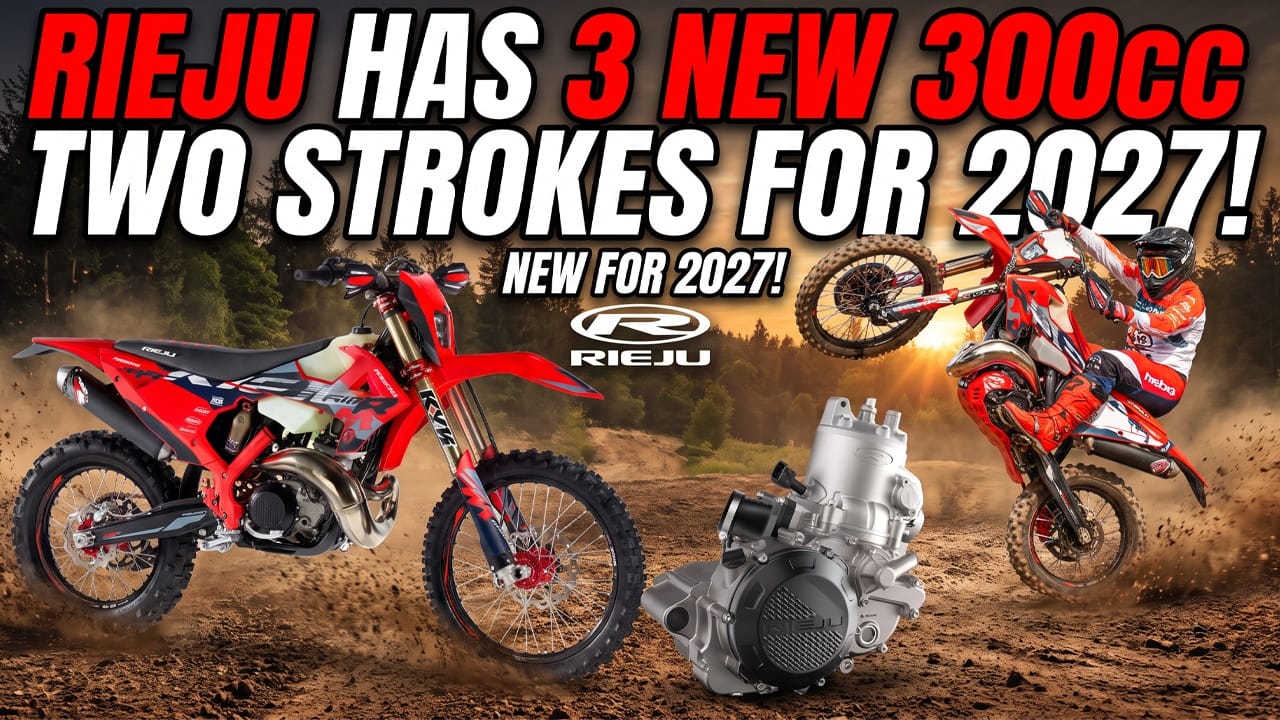
Rieju has renewed its MR 300i off-road range for the 2027 model year, splitting it into three distinct versions — Racing, Pro and Hard Enduro — all built around the same Spanish-made 298cc two-stroke single. Prices start at €9,499 for the Racing and top out at €11,199 for the Hard Enduro.
I’ve spent more evenings than I’d like to admit reading two-stroke spec sheets instead of doing literally anything useful around the house, and this one at least has the decency to be genuinely interesting: three versions of the same bike, each built for a different way of getting stuck in the woods.
The engine is shared across all three versions
Every 2027 MR 300i — Racing, Pro, and Hard Enduro — uses the same 298cc liquid-cooled two-stroke single, with TFI electronic fuel injection running two Bosch injectors tuned for high and low rpm separately. It breathes through a Moto Tassinari VForce4 reed valve, runs a six-speed gearbox with a multi-disc diaphragm clutch in an oil bath, and starts on the button, no kickstart backup needed. Three switchable power maps — Race, Forest, and Wet — let you flatten the delivery for slick roots without touching a jet.
None of that is new territory for a modern EFI two-stroke enduro bike, but it’s worth stating plainly: this isn’t a carbureted holdover with an injector bolted on for the brochure. The whole platform is designed around fuel injection from the frame up.
What actually changes between Racing, Pro, and Hard Enduro
For 2027 the whole range gets a new LED headlight and front mask — mostly a visibility and styling update — but the real differences are in the running gear, and they scale with how hard you plan to hit the terrain.
| Spec | Racing | Pro | Hard Enduro |
|---|---|---|---|
| Price | €9,499 | €10,599 | €11,199 |
| Front fork | KYB 48mm inverted | KYB 48mm, black DLC coating | KYB 48mm, black DLC coating |
| Handlebar | Neken 28mm | Renthal Fatbar 802 | Renthal Fatbar 802 |
| Front/rear tyres | Mitas Terra Force | Michelin Enduro | Michelin Enduro |
| Front brake | 260mm Galfer wave | 260mm Galfer floating wave | 260mm Galfer floating wave |
| Seat height | 949mm | 949mm | 929mm |
| Dry weight | ~102.6kg | ~103.5kg | ~104.5kg |
| Fuel capacity | ~9.8L | ~9.8L | ~9.8L |
The Hard Enduro is the one that actually earns the name rather than just wearing it as a trim badge. Rieju’s own spec sheet lists an inertia-weighted bushing, a heavy-duty water pump cover with a higher-flow impeller, a model-specific spark plug, a reinforced cooling system with its own expansion tank and a twin electric fan module, a shorter final-drive ratio with an AXP chain guide, a dedicated OXA exhaust tuned for hard enduro, a lowered foam seat, and a wider array of protection parts than either sibling gets. That’s the difference between “off-road capable” and “built to survive rock gardens,” and Rieju has priced the gap between them at exactly €1,700 over the Racing.
Frame geometry is shared across the range: a central-spine chrome-molybdenum steel chassis, 300mm of front travel, 310mm out back, a 1,475mm wheelbase and 320mm of ground clearance. So the Hard Enduro isn’t a different bike underneath the reinforcement — it’s the same chassis wearing the parts that stop it from breaking when things go wrong.
What we know / What’s still unclear
What we know: - All three variants share the 298cc two-stroke TFI engine, 6-speed gearbox, and central-spine steel frame - EUR pricing is confirmed for all three: €9,499 / €10,599 / €11,199 - The Racing model is already listed for sale through Rieju’s dealer network
What’s still unclear: - Exact delivery timing for the Pro and Hard Enduro versions hasn’t been published - Rieju hasn’t said whether the range will get an EU-wide unified launch date or stagger by market, the way some of its recent models have
Splitting one enduro platform into three genuinely different builds — rather than three colourways of the same bike — is the kind of move that makes me want to reorganise the garage I haven’t touched since spring, just to see if there’s room. It’s also a reminder that hard enduro is having a real moment right now: Manuel Lettenbichler just clean-swept Abestone on works equipment, and the gap between what he’s riding and what you can actually buy has never been narrower than a bike like this Hard Enduro closes it.
If you’re weighing this against something with a bit more electronic safety net for the days the terrain wins, it’s worth remembering KTM had to expand its own brake recall to off-road bikes just last week — a reminder that “hard enduro reliability” isn’t something any manufacturer gets to claim for free.
FAQ
How much does the 2027 Rieju MR 300i range cost?
Prices start at €9,499 for the Racing, €10,599 for the Pro, and €11,199 for the Hard Enduro — all EUR pricing direct from Rieju, a Spanish manufacturer.
What engine powers the Rieju MR 300i?
All three versions share a 298cc liquid-cooled two-stroke single with TFI electronic fuel injection, a six-speed gearbox, and electric start.
What’s the difference between the Racing, Pro, and Hard Enduro versions?
Suspension treatment (DLC-coated forks on Pro and Hard Enduro), handlebar and tyre choice, and — on the Hard Enduro specifically — a reinforced cooling system, shorter final drive, dedicated exhaust, and extra protection parts built for technical terrain.
Is the 2027 MR 300i range available now?
The Racing version is already listed through Rieju’s dealer network; exact delivery timing for the Pro and Hard Enduro hasn’t been published yet.
Official source: https://rieju.com/us/press/releases/new-mr-300i-my27-range/459/275
Reporting via: cyclenews.com, dirtbikemagazine.com, soymotero.net