Royal Enfield Classic 350 Spied With Factory Tubeless Wire-Spoke Wheels
1.5 kg unsprung delta + Flanged airtight rim architecture + Royal Enfield finally cures the retro puncture headache without ugly cast alloys.

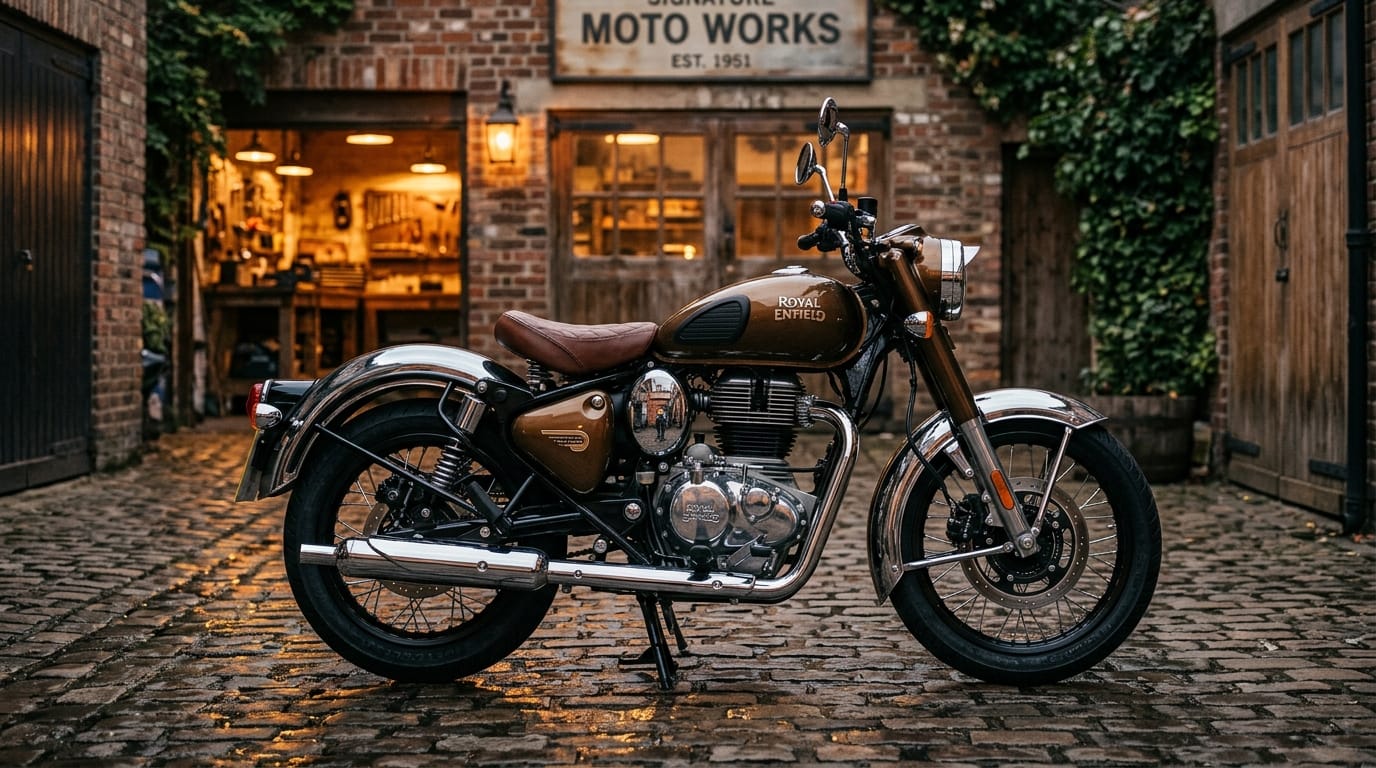
Royal Enfield appears ready to resolve the single most infuriating paradox of retro motorcycle ownership: loving wire-spoked wheels right up until you pick up a dry-wall screw forty kilometres from the nearest tyre changer. Fresh dealership sightings from India have revealed the Royal Enfield Classic 350 fitted with factory-developed tubeless wire-spoke wheels, a long-overdue upgrade that finally bridges traditional roadster styling with modern roadside puncture repairability.
For over a decade, riders drawn to the charming posture of the Royal Enfield Classic 350 have faced an irritating compromise. You either bought the retro wire-laced wheels and lived in perpetual dread of a pinched inner tube, or you conceded defeat and ordered cast alloy wheels that looked distinctly out of place on a machine styled after post-war British singles.
Tubeless Spoke Architecture: Center-Flange Engineering
The Royal Enfield Classic 350 test mules spotted on dealership floors feature an airtight rim profile utilizing a raised central outer flange to anchor the spoke nipples outside the pressurized tyre cavity. Rather than adopting the expensive cross-laced perimeter spoke design seen on the Himalayan 450, this configuration closely mirrors the wheel construction Royal Enfield debuted on the limited Meteor 350 Sundowner Edition.
Black powder-coated alloy rims contrast against polished stainless-steel spokes, shod directly with tubeless CEAT Zoom Plus rubber (100/90-19 front and 120/80-18 rear). By anchoring the spokes to a central structural spine isolated from the rim well, the design eliminates the need for internal rim tape or vulcanized rubber sealing bands that tend to degrade and leak after repeated heat cycles.
“A classic motorcycle should test your patience through mechanical character, not through forcing you to break the bead on an inner tube with tyre levers on the hard shoulder of a rain-soaked B-road.”
Mechanically, the rest of the Royal Enfield Classic 350 remains faithful to its proven architecture. Power comes from the air/oil-cooled 349cc J-series single-cylinder engine delivering 20.2 hp (15 kW) at 6,100 rpm and 27 Nm of peak torque at 4,000 rpm. The counterbalanced thumper channels drive through a slick 5-speed gearbox, settled inside a Harris Performance-engineered twin downtube spine frame with 41mm telescopic front forks and twin preload-adjustable emulsion rear shocks.
The Rider’s Trade-Off: Unsprung Mass Versus Roadside Sanity
Engineering an airtight tubeless rim with structural flange anchors adds roughly 1.2 to 1.8 kilograms of rotating unsprung mass compared to a standard drilled tube-type steel wheel. On a 20.2-horsepower roadster tipping the scales near 195 kg wet, adding rotating inertia marginally dulls low-speed steering flickability through tight city roundabouts and requires slightly more damping control over square-edged potholes.
Yet for anyone who actually rides outside mobile phone signal range, that penalty is an absolute bargain. Plugging a tubeless puncture takes four minutes with a sticky cord kit and a CO2 inflator, without ever dropping the rear axle, disconnecting the drum or disc brake linkage, or wrestling heavy steel tyre irons against freshly painted wheel rims.
Side-by-Side Comparison: Wheel Configurations and Segment Rivals
| Specification | Classic 350 Tubeless Spoke (Spied) | Classic 350 Tube-Type Spoke | Triumph Speed 400 |
|---|---|---|---|
| Engine Architecture | 349cc SOHC Air/Oil Single | 349cc SOHC Air/Oil Single | 398cc DOHC Liquid Single |
| Power Output | 20.2 hp @ 6,100 rpm | 20.2 hp @ 6,100 rpm | 39.5 hp @ 8,000 rpm |
| Peak Torque | 27.0 Nm @ 4,000 rpm | 27.0 Nm @ 4,000 rpm | 37.5 Nm @ 6,500 rpm |
| Wheel Construction | Airtight Flanged Wire-Spoke | Traditional Drilled Wire-Spoke | Cast Aluminium Alloy |
| Tyre Configuration | Tubeless (100/90-19 F, 120/80-18 R) | Tube-Type (100/90-19 F, 120/80-18 R) | Tubeless (110/70-17 F, 150/60-17 R) |
| Kerb Weight (Wet) | ~196 kg (est.) | 195 kg | 176 kg |
| Base European Price | ~€5,450 (est. premium) | €5,199 | €5,795 |
While riders stepping up from entry-level commuter machines often cross-shop modern roadsters like the Triumph Speed 400 or benchmark A2-licence-legal motorcycles, the Classic 350 occupies an entirely different emotional space. Adding tubeless reliability protects its vintage silhouette while removing its greatest day-to-day usability flaw.
What We Know vs. What’s Still Unclear
What We Know: - Dealership units confirm finished production-spec wheels fitted to the Classic 350 in Medallion Bronze paint. - The wheels use a central flange architecture running verified tubeless road tyres without inner tubes. - The underlying 349cc J-series powertrain, Harris Performance chassis, and ByBre braking hardware remain unchanged.
What’s Still Unclear: - Whether Royal Enfield will launch these wheels as a standalone flagship trim (similar to the Royal Enfield Classic 650 Hypershift) or offer them as an official MiY catalogue retrofit for existing owners. - The exact price premium for European and UK dealerships, though domestic pricing hints at an increase of approximately €250 to €300 over base spoked models. - The official launch date, widely expected at the Motoverse 2026 festival in Goa later this month.
Media citation: Editorial outlets and forums may quote excerpts with attribution and a link to Throttle Times.
Reporting via: bikewale.com, autocarindia.com