2027 Royal Enfield Interceptor 650 Spied: Twin Front Discs and Lighter Chassis
2 front discs replace single rotor + 648cc twin retained at 47 hp + Royal Enfield protects its European A2 licence sweet spot with real brakes.

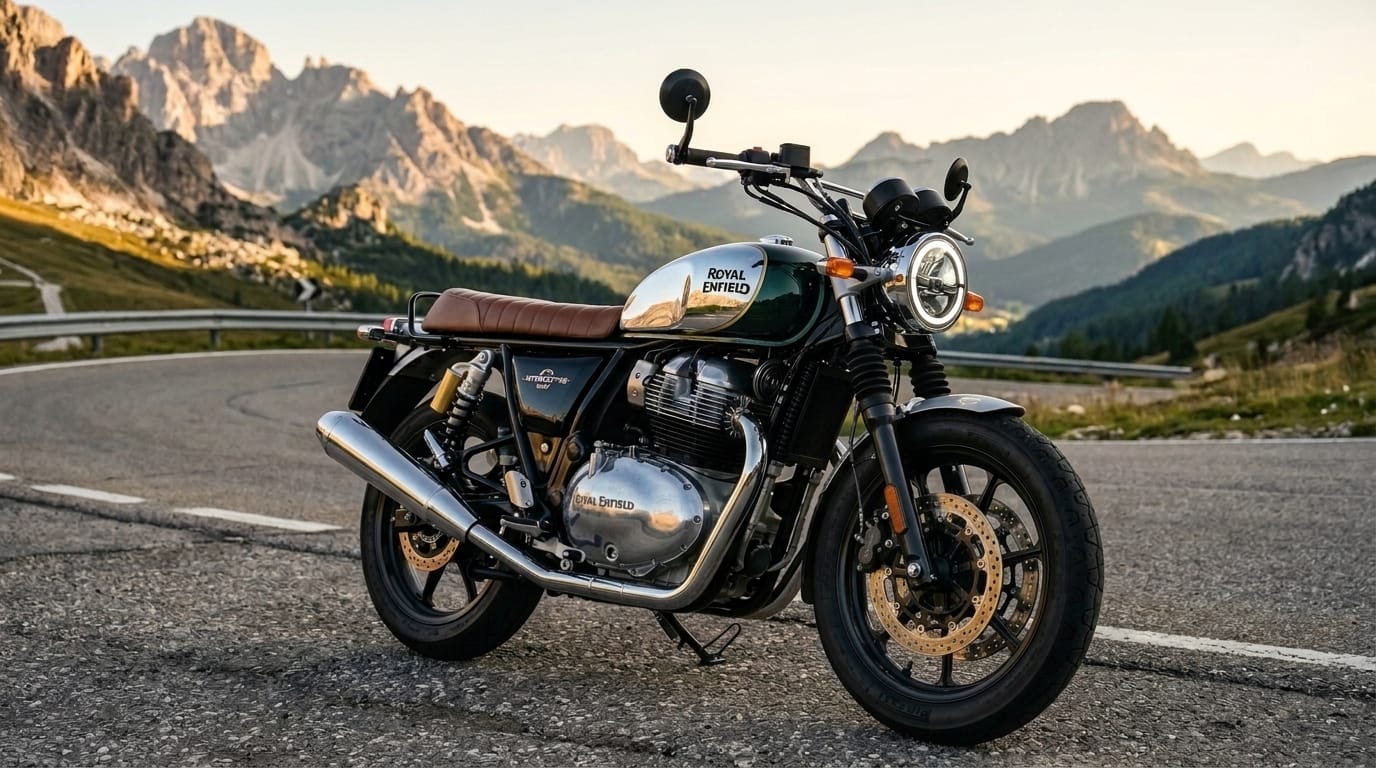
Royal Enfield has begun public road testing of a comprehensive mid-lifecycle update for the Interceptor 650, targeting the twin mechanical compromises that European owners have spent six years modifying in their own garages. Development mules spotted on Indian highways and suburban test loops reveal that the Chennai manufacturer has finally added a twin-disc front brake assembly to its flagship modern-classic roadster, paired with targeted chassis revisions to shed kilograms from the bike’s portly wet mass.
While Royal Enfield recently captured headlines with its upcoming 750cc parallel-twin platform, the 2027 Interceptor is deliberately staying in its lane. By keeping the proven 648cc displacement and 47 hp ceiling, Royal Enfield is safeguarding the single most important commercial asset in its European export catalog: frictionless, restrictor-free A2 licence compliance.
Braking Hardware Overhaul: Dual Front Rotors Replace the Single Disc
The most glaring update on the 2027 Interceptor 650 development prototype is a symmetrical twin-disc front braking system. Where the original machine relied on a single 320 mm front rotor clamped by a two-piston sliding ByBre caliper, the updated mule carries dual floating discs gripped by twin two-piston axial calipers fed by braided stainless-steel lines.
“Test mules of the updated Interceptor 650 confirm dual front brake discs mounted to cast-alloy wheels, correcting the noticeable brake fade that owners frequently reported when hustling 218 kilograms of steel and fuel down steep alpine passes.”
The addition of a second front disc significantly increases thermal dissipation capacity and pad bite under emergency stops. Royal Enfield’s chassis engineers have paired the revised braking hardware with a reinforced lower telescopic fork slider to prevent torsional axle twist under heavy single-track emergency braking, providing far more communicative lever feel on wet winter commutes.
Chassis Geometry and Mass: Defending the European A2 Sweet Spot
Royal Enfield has retained its 648cc air/oil-cooled 270-degree parallel twin without bumping displacement, keeping power output locked at exactly 47 hp (35 kW) and 52 Nm of torque. This choice is calculated: it guarantees that any rider holding a European A2 licence can buy and ride the Interceptor straight off the showroom floor without throttle stops or ECU restrictors.
Chassis engineers are reportedly applying weight-reduction measures to the double-cradle steel frame, targeting a curb weight drop closer to 210 kg compared to the outgoing generation’s hefty 218 kg wet figure. The test mule also sports black multi-spoke alloy wheels wrapped in tubeless road rubber, a circular LED headlamp, and a modern single-pod circular instrument cluster borrowed from the Himalayan 450, offering turn-by-turn navigation mirroring. The strategic focus on accessible modern classics follows Royal Enfield’s record quarterly deliveries, proving that accessible middleweights out-sell fragile exotics.
The Rider’s Trade-Off: Unsprung Mass vs Stopping Power
Every braking upgrade on a budget-conscious middleweight brings a mechanical trade-off. Bolting a second cast-iron disc, mounting bracket, and hydraulic caliper onto the front hub adds roughly 2.5 kg of unsprung rotational inertia right at the front wheel axle.
On corrugated pavement or broken backroads, that additional unsprung mass will make the front fork work harder to track sharp surface imperfections. Yet for any rider who has experienced brake fade when descending hairpins two-up with luggage, swapping a fraction of high-speed steering flickability for predictable two-finger stopping power is a trade worth making every single day. As seen on purpose-built A2-licence motorcycles and limited editions like the Classic 650 Hypershift, solid chassis fundamentals matter far more than spec-sheet boasting.
Technical Comparison: 2027 Interceptor Facelift vs Predecessor
| Specification | 2027 Interceptor 650 (Est.) | Current Interceptor 650 | Continental GT 650 |
|---|---|---|---|
| Engine Architecture | 648cc SOHC Parallel Twin | 648cc SOHC Parallel Twin | 648cc SOHC Parallel Twin |
| Power Output | 47 hp (35 kW) @ 7,150 rpm | 47 hp (35 kW) @ 7,150 rpm | 47 hp (35 kW) @ 7,150 rpm |
| Peak Torque | 52.3 Nm @ 5,150 rpm | 52.3 Nm @ 5,150 rpm | 52.3 Nm @ 5,150 rpm |
| Front Brakes | Dual 300 mm Discs, 2-Piston ByBre | Single 320 mm Disc, 2-Piston ByBre | Single 320 mm Disc, 2-Piston ByBre |
| Wet Weight (Kerb) | ~210 kg (est.) | 218 kg | 214 kg |
| Instrumentation | Single-Pod TFT with RoadSync | Twin-Pod Analogue / LCD | Twin-Pod Analogue / LCD |
| Wheels & Tyres | 18-Inch Alloy Tubeless | 18-Inch Spoke / Alloy Tubeless | 18-Inch Alloy Tubeless |
| European Base Price | ~€7,390 (est.) | €6,990 | €7,290 |
What We Know / What’s Still Unclear
What We Know: - Twin Front Discs: Dual front disc brakes are confirmed by multiple running test mules, replacing the single rotor setup. - 648cc Engine Retained: The 47 hp powertrain remains unchanged to protect the A2 licence classification. - Modern Cockpit: The dated twin-pod clocks are replaced by a single-pod circular digital display with navigation mirroring. - Tubeless Alloys: The test mule runs factory alloy wheels with tubeless tires, eliminating tube-puncture anxiety on long tours.
What’s Still Unclear: - Suspension Cartridge Internals: Whether Royal Enfield has updated the fork damper valving or simply retained the soft stock springs remains to be tested. - Exhaust Weight: It is unconfirmed whether lighter exhaust headers will accompany the facelift or if Euro 5+ catalytic converters will retain the heavy twin cans. - European Launch Window: European dealer arrivals are projected for mid-2027 following an expected EICMA 2027 unveiling.
Media citation: Editorial outlets and forums may quote excerpts with attribution and a link to Throttle Times.
Reporting via: autocarindia.com, timesofindia.indiatimes.com, bikewale.com