Benda's New Supercharger Patent Tucks the Boost Right Into the Crankcase
A gear-driven centrifugal supercharger mounted low on the engine cases and lubricated by engine oil — Benda just patented a very different forced-induction V-twin.

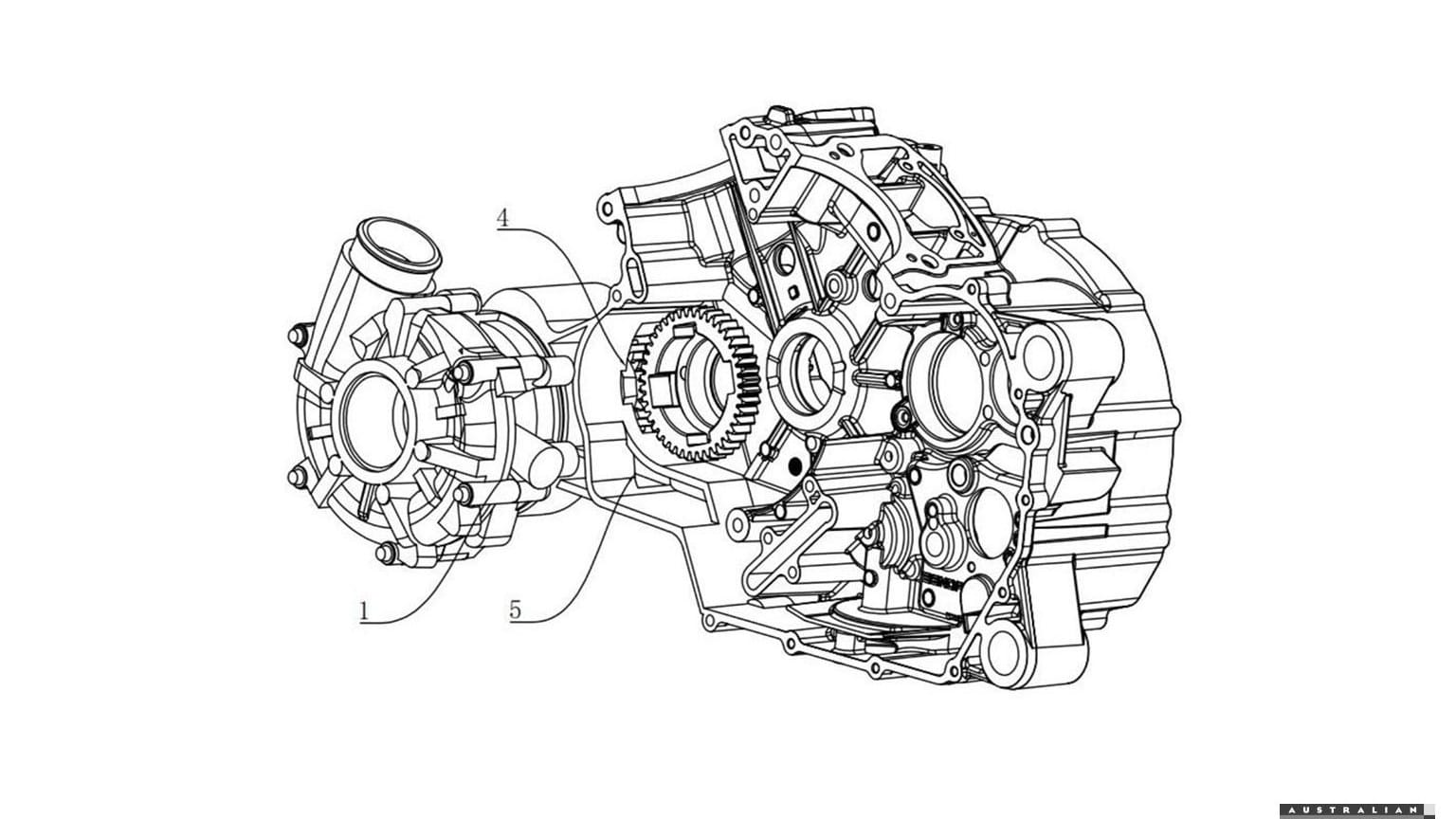
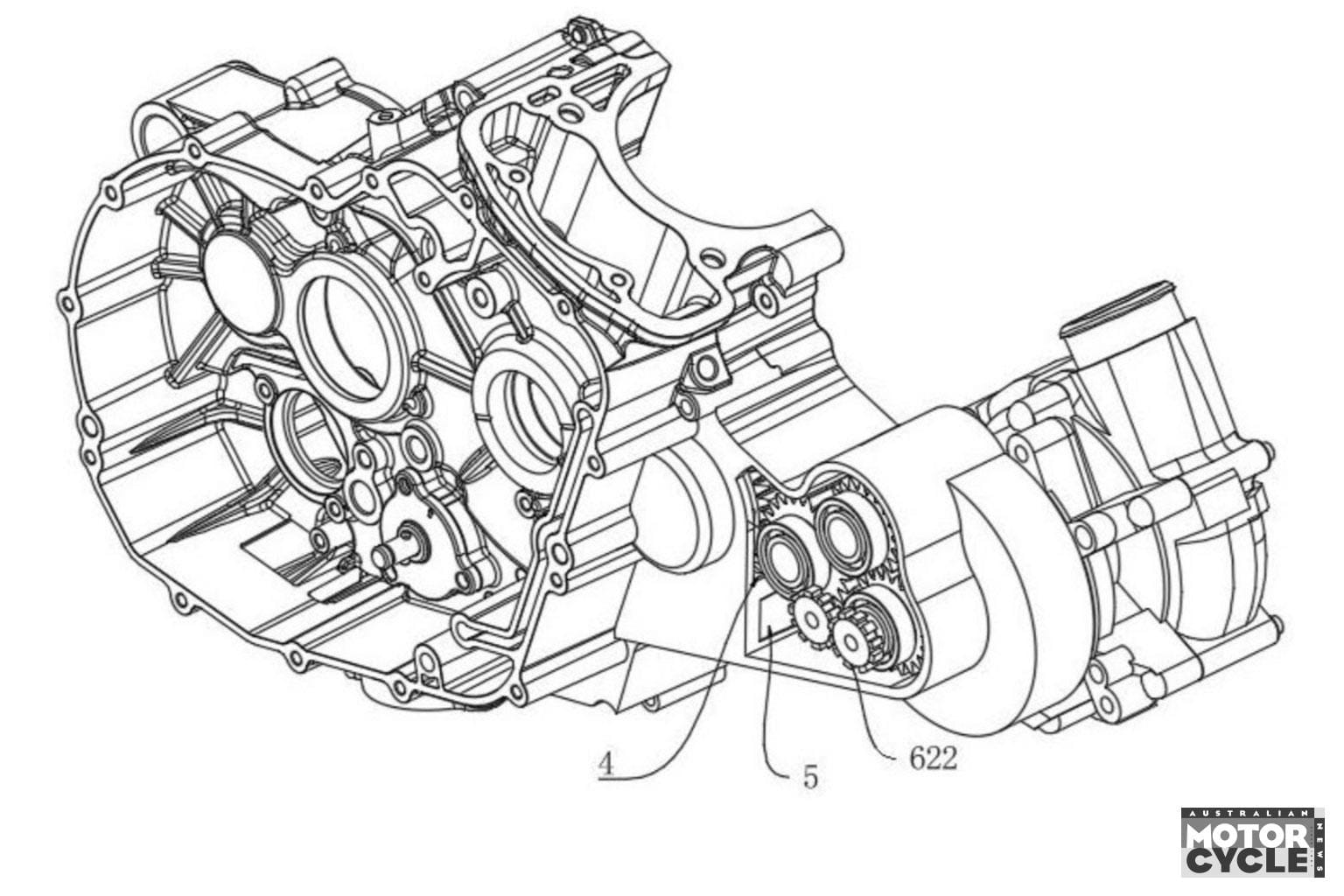
Patent filings published from Chinese motorcycle manufacturer Benda reveal a brand-new forced-induction engine architecture that integrates a gear-driven centrifugal supercharger directly into the front of the crankcase. Every time I convince myself that Chinese engineering is content to copy existing Japanese parallel twins, one of these obscure design houses files a blueprint that looks like someone handed a CAD workstation to an unhinged drag-racing mechanic.
The Front-Mounted Centrifugal Supercharger Architecture
The Benda supercharged V-engine positions its centrifugal compressor low down at the very front of the engine cases, driven mechanically off the crankshaft via a dedicated internal gear train. Unlike the Kawasaki Ninja H2, which places its supercharger high up behind the cylinder block above the transmission, the Benda supercharged V-engine uses an extension cast directly into the forward crankcase to house both the step-up gearing and the compressor impeller. Mounting the assembly low and forward lowers the overall centre of gravity and places the induction blower directly in the path of incoming cool air from behind the front wheel.
Rather than relying on an isolated oil reservoir with proprietary fluid, the patent documents demonstrate that the supercharger’s high-speed drive gears are fed directly by the motorcycle’s primary engine oil circuit. Lubricating the drive train directly from the sump simplifies scheduled servicing for European owners, though it places extreme demands on oil filtration and thermal cooling given the massive rpm multiplication required to spin a centrifugal impeller to boost thresholds.
| Feature | Design Specification |
|---|---|
| Engine Architecture | Liquid-cooled overhead-cam V-engine (V-twin or V4) |
| Forced Induction Type | Centrifugal supercharger |
| Mounting Location | Forward crankcase extension, low-slung ahead of cylinders |
| Drive Mechanism | Direct crankshaft gear train with internal step-up ratio |
| Lubrication System | Integrated primary engine-oil circulation |
| Parent Patent Assignee | Hangzhou Saturn Power Technology Co., Ltd. (Benda) |
| Patent Classification | CNIPA forced-induction motorcycle powertrain |
How Benda Fits Into China’s High-Output Ambitions
While European buyers are only beginning to take four Chinese manufacturers seriously in volume segments, Benda has built its reputation on engineering eccentric mechanical configurations. From small-displacement V4 cruisers to wide-tyre custom roadsters, Benda’s engine subsidiary, Hangzhou Saturn Power Technology, operates with surprising technical freedom. The brand previously teased a 300cc turbocharged sports concept dubbed the VTR300 Turbo, but this latest filing confirms that mechanical supercharging remains an active engineering program.
Much like CFMoto’s V4 SR-RR has pushed Chinese performance benchmarks toward WorldSBK territory, Benda’s pursuit of forced induction aims to deliver big-displacement horsepower and torque without paying the weight and packaging penalties of a larger engine block.
What We Know / What’s Still Unclear
What We Know
- The patent is assigned to Hangzhou Saturn Power Technology Co., Ltd., the proprietary powertrain division of Benda.
- The centrifugal supercharger is gear-driven from the crankshaft and shares the main engine’s oil supply.
- The base engine is a multi-cylinder V-configuration with overhead camshafts.
- The forward low-mounted position keeps the blower in direct airflow while keeping mass concentrated low in the chassis.
What’s Still Unclear
- Exact cylinder count and engine displacement (the cross-section shows one cylinder bank clearly, leaving V-twin versus V4 ambiguous).
- Boost pressures, power figures, and emissions compliance readiness for European Euro 5+ standards.
- Whether Benda plans to put this engine into a production roadster, cruiser, or sports model, or keep it as an internal research study.
Frequently Asked Questions
What does Benda’s new patent reveal?
The patent reveals a forced-induction motorcycle engine with a centrifugal supercharger mounted low on the front of the crankcase, gear-driven directly off the crankshaft.
How does Benda’s supercharger layout differ from Kawasaki’s Ninja H2?
While Kawasaki places the Ninja H2 supercharger high up behind the cylinder block above the transmission, Benda integrates the compressor low in front of the engine block to keep the center of gravity down and allow direct cooling from frontal airflow.
What engine configuration is shown in the patent?
The patent drawings display an overhead-cam V-engine architecture, though whether it is a small-displacement V-twin or a larger V4 remains unconfirmed.
Is this supercharged motorcycle confirmed for production?
Benda has not officially announced a production timeline or commercial model name, making it an active R&D patent application.
Reporting via: amcn.com.au