BSA Thunderbolt 350 Debuts at EICMA: 334cc Thumper and 21-Inch Front Hoop
29.2 hp & 21-inch front hoop + 334cc liquid-cooled single with exoskeleton crash bars and 15.5L cell + BSA swaps retro cafe posing for genuine dirt trail capability.

Part of Throttle Times’ live coverage of EICMA 2026.
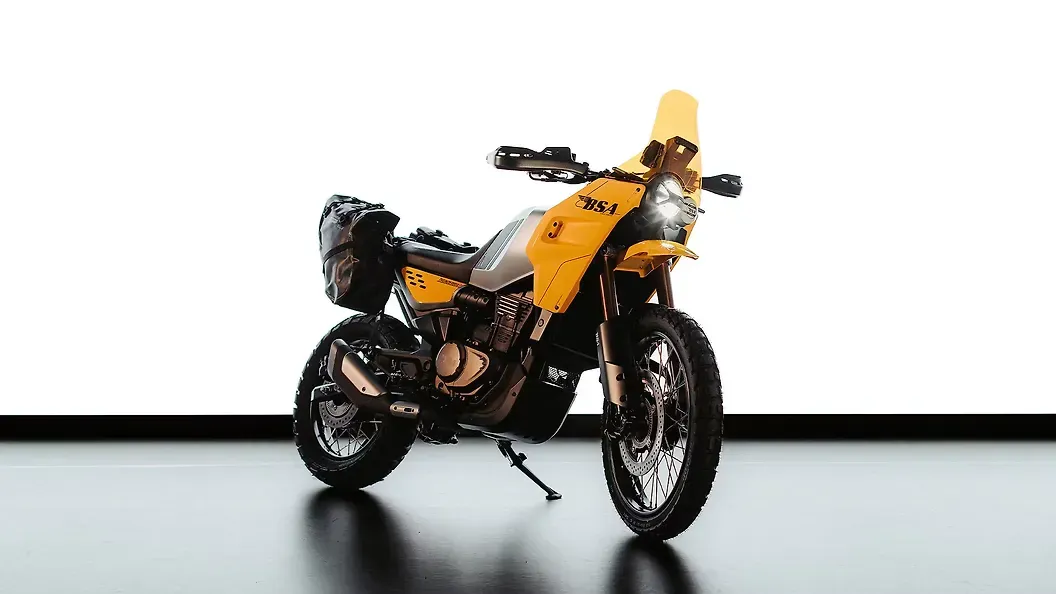
BSA has officially broken out of its retro-roadster comfort zone at EICMA 2026 in Milan, unveiling the BSA Thunderbolt 350 as a production-ready entry into the thriving lightweight dual-sport adventure market. Rather than offering another chrome-accented boulevard cruiser, the revived British marque—backed by parent company Classic Legends—has turned the historic Thunderbolt moniker into a legitimate, dirt-focused single aimed squarely at European A2 trail riders and global overlanders.
With rally-inspired upright proportions, an external protective exoskeleton, and an off-road wheel combination, the Thunderbolt 350 signals BSA’s intent to compete directly against category favorites like the Royal Enfield Himalayan 450 and CFMoto 450MT.
The 334cc DOHC Thumper: 29 HP and Euro 5+ Emissions
The Thunderbolt 350 is driven by a 334cc liquid-cooled single-cylinder DOHC 4-valve engine generating 29.2 hp (21.5 kW) at 7,750 rpm and 30 Nm of peak torque at 5,750 rpm. Built with twin-spark ignition and a counterbalancer shaft to quench mechanical vibrations through the footpegs, the motor delivers a broad, tractable torque spread tuned specifically for crawling over loose mountain scree.
Power is routed through a 6-speed gearbox fitted with an assist-and-slipper clutch, keeping lever effort light during technical standing sections. Fuel is drawn from a 15.5-litre steel tank that, combined with an estimated fuel burn of 3.4 litres per 100 km, yields an overland touring range well exceeding 420 km between petrol stops.
“We looked back at BSA’s competitive trials and desert heritage from the 1960s and asked what a modern privateer actually needs: a simple, unburstable single-cylinder powerplant, proper 21-inch rolling stock, and crash protection that does not require an aftermarket catalogue,” stated BSA design directors on the show floor.
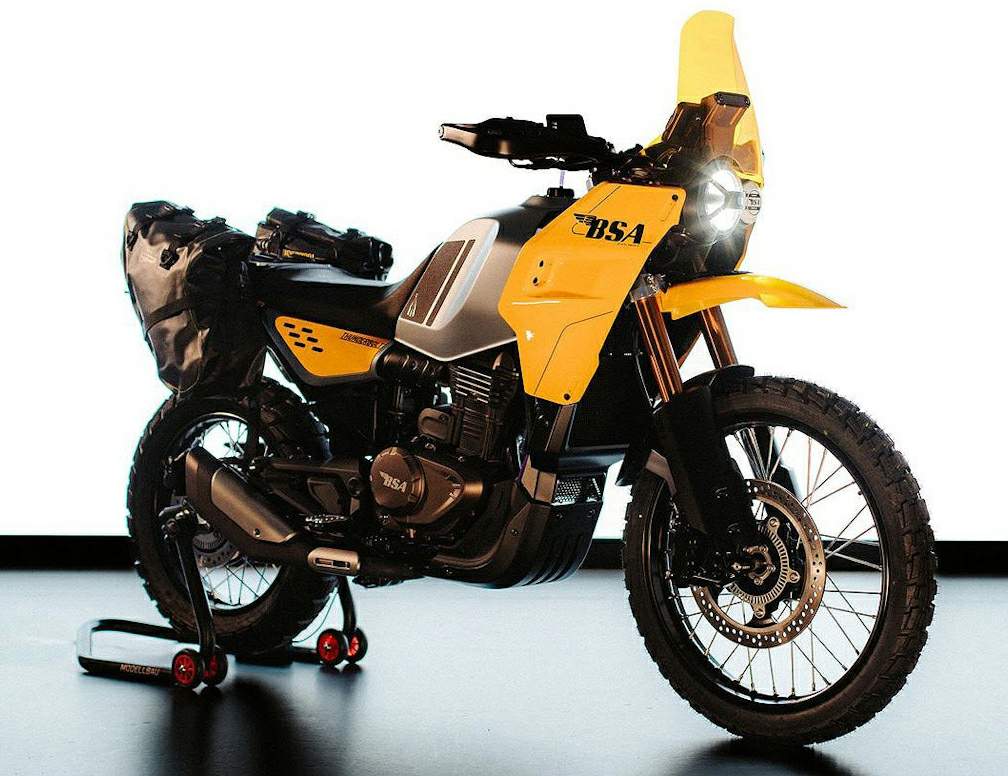
Dirt Hardware: 21-Inch Spoked Wheels, 43mm Forks, and Exoskeleton Frame
Chassis architecture is centered around a heavy-duty steel cradle frame integrated with an exposed tubular exoskeleton that wraps around the engine cases and radiator shroud, doubling as mounting points for auxiliary lighting and soft luggage.
Up front, the Thunderbolt runs a 43mm inverted front fork delivering 200 mm of wheel travel, paired with a linkage-assisted rear monoshock offering 190 mm of travel with 5-step preload adjustability. Wire-spoked wheels are shod in dual-purpose knobbies using a genuine off-road 21-inch front and 17-inch rear configuration. Stopping power relies on a 300 mm front disc with a ByBre dual-piston floating caliper and a 240 mm rear disc, managed by a dual-channel ABS system with three selectable modes: Road, Rain, and an Off-Road setting that completely disengages rear wheel intervention.
Rider accommodations include a comfortable 825 mm saddle, wide motocross-bend alloy handlebars, and a vertically oriented LCD rally console equipped with Bluetooth turn-by-turn navigation and dual USB-C charging ports.
The Rider’s Trade-Off: Mechanical Simplicity vs High-Speed Motorway Legs
The Thunderbolt 350’s primary compromise lies in its modest top-end reserve. With 29.2 hp hauling a wet weight near 188 kg, the BSA is dialed for agility on technical forestry tracks, gravel passes, and B-road exploration, but it will work hard when asked to sustain 130 km/h motorway cruises into a headwind across European autoroutes.
Riders cross-shopping machines featured in our roundup of The Best A2-Licence-Legal Adventure Bikes You Can Actually Buy in 2026 will notice that modern multi-cylinder and higher-displacement singles—like the freshly launched Hero Debuts Production Xpulse 450 at EICMA—offer up to 47 hp for open-road passes. However, what the BSA gives up in sheer motorway velocity, it claws back in rugged build quality, accessible seat height, and predictable single-cylinder low-end tractability.
Technical Comparison: BSA Thunderbolt 350 vs Rivals
| Specification | BSA Thunderbolt 350 | Royal Enfield Himalayan 450 | CFMoto 450MT |
|---|---|---|---|
| Engine Architecture | 334cc DOHC Single | 452cc DOHC Single | 449cc 270° Parallel-Twin |
| Peak Power | 29.2 hp (21.5 kW) @ 7,750 rpm | 40 hp (29.4 kW) @ 8,000 rpm | 43.6 hp (32 kW) @ 8,500 rpm |
| Peak Torque | 30 Nm @ 5,750 rpm | 40 Nm @ 5,500 rpm | 44 Nm @ 6,250 rpm |
| Front Wheel Setup | 21-inch Wire-Spoke | 21-inch Wire-Spoke | 21-inch Tubeless Spoke |
| Suspension Travel (F/R) | 200 mm / 190 mm | 200 mm / 200 mm | 200 mm / 200 mm |
| Fuel Tank Capacity | 15.5 Litres | 17.0 Litres | 17.5 Litres |
| Wet Weight | 188 kg | 196 kg | 190 kg (dry) |
| European Price Target | ~€5,490 (est.) | €5,900 | €5,990 |
European Pricing and Market Launch
BSA plans to roll out the Thunderbolt 350 across UK and European dealer networks starting in March 2027. European pricing is targeted at approximately €5,490 (£4,795 in the UK), strategically undercutting European 400-500cc competitors by several hundred euros to appeal to budget-conscious adventure tourers.
Media citation: Editorial outlets and forums may quote excerpts with attribution and a link to Throttle Times.
Official source: https://www.bsacompany.co.uk/news/bsa-thunderbolt-350-revealed-eicma-2026/
Reporting via: motornieuws.be