Macbor Montana XR6 Debuts: 66 HP Twin, Adaptive Suspension, and ARAS Radar
66 hp & 625cc twin + Electronic adaptive suspension with variable seat height + Macbor debuts an ambitious Spanish middleweight packed with radar safety.

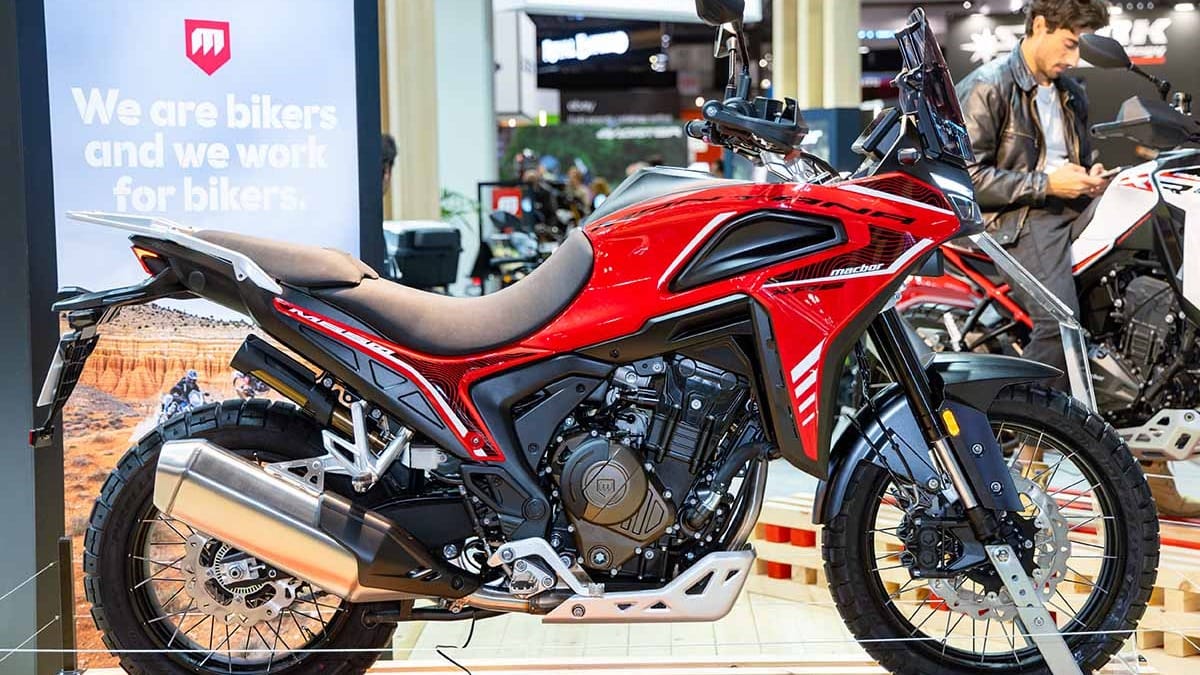
Part of Throttle Times’ live coverage of EICMA 2026.
Spanish motorcycle manufacturer Macbor, backed by Barcelona-based distributor Motos Bordoy, has staked a major claim in the middleweight adventure touring sector with the world premiere of the Macbor Montana XR6 prototype at EICMA 2026 in Milan. Stepping up from the brand’s popular A2-focused Montana XR5 510, the XR6 represents a dramatic technical leap forward for the Iberian marque. Powered by an all-new liquid-cooled 625cc parallel-twin producing 66 hp (49 kW) and 59 Nm of torque, the prototype arrives equipped with full dual electronic adaptive suspension, variable automated seat height adjustment, and an automotive-grade Advanced Rider Assistance Systems (ARAS) radar safety suite.
Rather than competing purely on rock-bottom acquisition costs, Macbor is using its Milan showcase to preview how high-end electronic suspension and active radar tech can democratize the sub-700cc adventure segment. The XR6 bridges the gap between accessible lightweight thumpers and full-dress continent-crossers, aligning with the electronic technology wave showcased by systems like Honda SENSING RIDE while offering riders turnkey semi-active damping.
625cc Parallel-Twin Architecture and Ride-by-Wire Control
At the heart of the Montana XR6 is an all-new 625cc liquid-cooled parallel-twin engine engineered specifically for Euro 5+ emissions and noise thresholds. Configured with dual overhead camshafts (DOHC) and four valves per cylinder, the powerplant incorporates a 270-degree crankshaft firing interval to deliver V-twin-like exhaust cadence and linear low-end tractability over loose terrain. Bosch electronic fuel injection and a full ride-by-wire electronic throttle system manage power delivery, yielding a peak output of 66 hp at 8,500 rpm alongside 59 Nm of torque at 6,500 rpm.
Power is metered through a multi-disc slipper-assist clutch that prevents rear-wheel hopping during aggressive downshifts, linked to a six-speed manual transmission equipped with a bi-directional quickshifter. Riders can toggle through four tailored engine maps—Eco, Rain, Sport, and Off-Road—altering throttle response curve, engine braking intervention, and traction control slip thresholds. The off-road mapping permits complete deactivation of rear-wheel ABS and traction control for loose-surface gravel drift control.
“The Montana XR6 represents our vision for the next decade of Spanish adventure motorcycling. We refused to compromise on electronic rider safety and adaptive chassis control simply because this sits in the mid-displacement class.” — Macbor Design Team, EICMA Milan
Adaptive Electronic Damping and Automotive-Grade Radar Safety
The technical highlight of the Montana XR6 is its dual electronic adaptive suspension system. Both the inverted front fork and linkage-assisted rear monoshock feature electronically controlled solenoid valves that continuously modulate compression and rebound damping in milliseconds based on road surface feedback, lean angle, and acceleration telemetry. Furthermore, the system incorporates an automatic ride-height lowering function, which automatically reduces the seat height from 835 mm down to an accessible 810 mm as the motorcycle slows to a standstill at traffic lights.
Active safety receives an equally thorough upgrade courtesy of an integrated millimeter-wave radar sensor suite. Operating in conjunction with high-mount front and rear cameras, the XR6 provides: - Blind Spot Detection (BSD): Optical radar warning strobes embedded into the rearview mirrors when trailing vehicles enter blind sectors. - Lane Change Assist (LCA): High-frequency flashing alerts when indicating across lanes occupied by rapidly approaching traffic. - Rear Collision Warning (RCW): Automatic hazard light pulsing to warn trailing drivers when closure rates exceed safe thresholds.
The cockpit houses an expansive 6.75-inch full-color TFT display featuring full smartphone mirror-link navigation, continuous front and rear dashcam recording playback, tyre pressure monitoring (TPMS), and dual USB-C charging ports tucked adjacent to a 20-liter long-range fuel cell.
Technical Comparison: Macbor Montana XR6 vs Mid-ADV Rivals
| Specification | Macbor Montana XR6 (Prototype) | Macbor Montana XR5 510 | Benelli TRK 702X |
|---|---|---|---|
| Engine Configuration | 625cc Parallel-Twin, 270° Crank | 498cc Parallel-Twin, 180° Crank | 698cc Parallel-Twin, 180° Crank |
| Peak Power | 66 hp (49 kW) @ 8,500 rpm | 47 hp (35 kW) @ 8,500 rpm | 70 hp (51.5 kW) @ 8,000 rpm |
| Peak Torque | 59 Nm @ 6,500 rpm | 45 Nm @ 7,000 rpm | 70 Nm @ 6,000 rpm |
| Suspension Hardware | Electronic Adaptive USD & Monoshock | 41mm KYB USD (Manual Adj.) | 50mm USD (Non-Adjustable) |
| Seat Height | 810 mm – 835 mm (Variable Auto) | 840 mm (Fixed) | 835 mm (Fixed) |
| Wheel Sizes (F/R) | 19-inch / 17-inch Cross-Spoked | 19-inch / 17-inch Cross-Spoked | 19-inch / 17-inch Spoked |
| Electronics & Radar | Semi-Active Damping, ARAS Radar, Cameras | Standard ABS & 2 Ride Modes | Standard ABS, No Radar |
| Fuel Capacity | 20.0 Liters | 20.0 Liters | 20.0 Liters |
The comparison highlights Macbor’s ambition: while the Benelli TRK 902 Xplorer moves upward into the 900cc category, Macbor integrates semi-active suspension and active radar safety into a lightweight 625cc footprint that rivals middleweight electronic pioneers like the CFMoto 800MT-ES.
The Rider’s Trade-Off: Sensor Complexity vs Field Serviceability
The primary mechanical trade-off of the Montana XR6 centers on electronic complexity versus remote-trail field serviceability. By packaging solenoid-governed adaptive dampers, servo-driven variable seat lowering, dual radar transceivers, and front/rear optical cameras into a mid-capacity adventure bike, Macbor provides unprecedented touring comfort and urban confidence for shorter-inseam riders. However, this dense electronic umbilical requires complex wiring harnesses, multi-pin waterproof bus connectors, and extensive electronic control units (ECUs).
While standard mechanical forks and monoshocks can be rebuilt or limped back to civilization by a roadside mechanic with generic seals and 10W fork oil, an electronic actuator failure or damaged radar antenna cannot be patched trailside. For riders contemplating transcontinental tracks across the Balkans or North Africa, sensor fragility and diagnostic dependence remain factors that demand careful consideration against pure highway luxury.
Production Timeline and Market Outlook
Macbor presented the Montana XR6 at EICMA 2026 as an advanced production prototype, with final European homologation testing scheduled throughout 2027. Official European pricing and regional delivery schedules will be announced ahead of dealership rollout, with market observers anticipating a target price point hovering around €7,800 to €8,400 across Mediterranean dealer networks.
Media citation: Editorial outlets and forums may quote excerpts with attribution and a link to Throttle Times.
Official source: https://www.macbor.com/
Reporting via: moto1pro.com