Harley-Davidson Patents Automated Emergency Braking With Rider Gaze Tracking
0.6G threshold & 15° lean cutoff + Front radar paired with cockpit gaze-tracking cameras + Harley patents autonomous emergency braking that stops the bike without ejecting the rider.

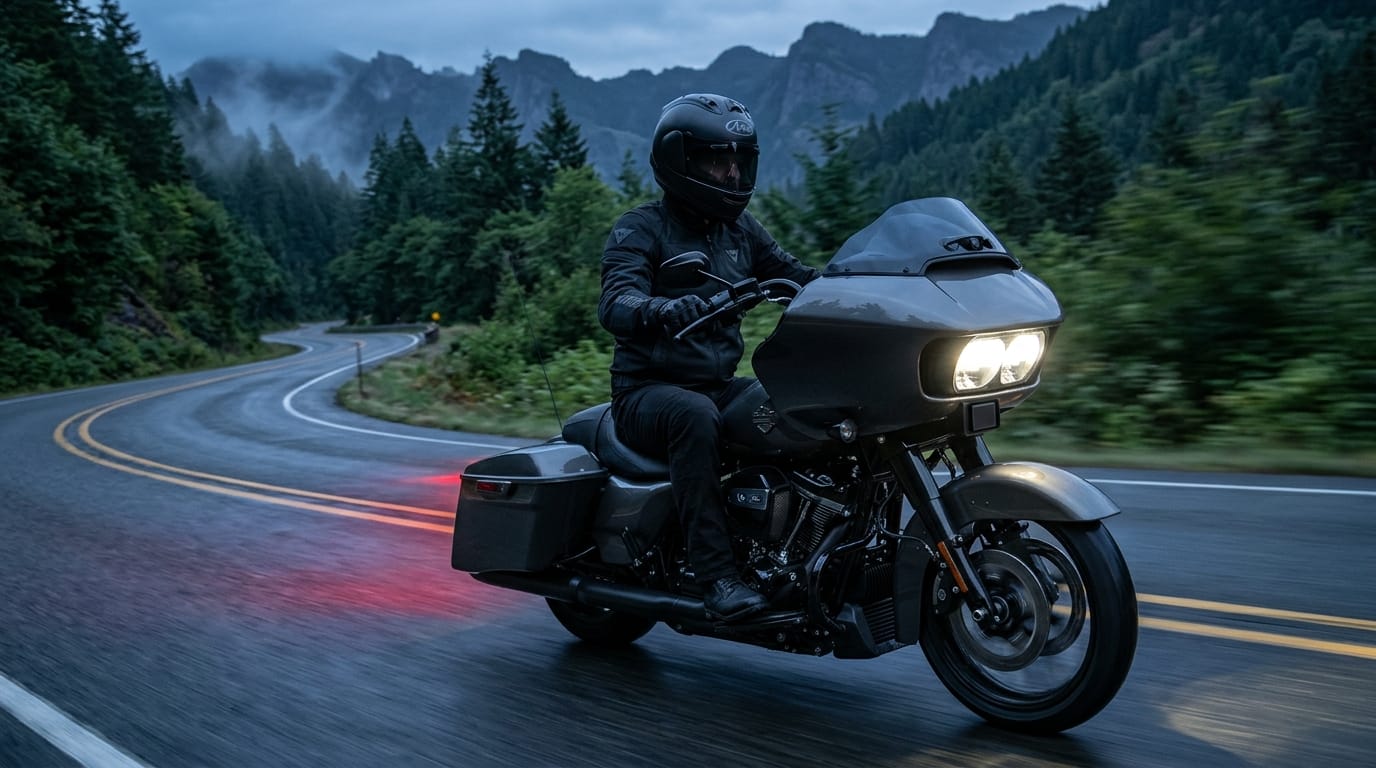
Harley-Davidson has published extensive technical patent filings detailing an autonomous Automated Emergency Braking (AEB) system engineered specifically to resolve the fundamental paradox of motorcycle automation: how to stop a two-wheeled vehicle in an emergency without ejecting or high-siding the rider. In automotive engineering, slamming on the brakes autonomously is a solved problem involving seatbelts and passenger crumple zones. On a 380 kg Milwaukee-Eight touring motorcycle navigating a wet European mountain pass, an unprompted full-pressure caliper grab would instantly break front-tire traction or pitch the unprepared rider over the fairing. Harley-Davidson’s solution marries external 77 GHz radar arrays with an intrusive suite of internal rider-monitoring sensors that verify physical posture and eye gaze before the ECU intervenes.
Millimeter Radar Meets Facial Gaze Tracking
The Harley-Davidson Automated Emergency Braking patent outlines a multi-layered sensor architecture integrating forward-facing millimeter-wave radar mounted in the nose fairing with optical and infrared cameras embedded directly into the inner cockpit dash. Rather than delegating collision avoidance entirely to radar distance metrics, the motorcycle’s central safety computer continuously monitors the rider’s physiological state through handlebar grip load cells, seat pressure pads, and facial recognition cameras tracking eye gaze angle and helmet orientation.
If forward radar identifies a stationary vehicle or decelerating obstacle within the motorcycle’s projected path, the system first checks whether the rider’s gaze is fixed on the hazard. If the rider is looking away—distracted by scenery, a mirror check, or a GPS prompt—the Harley-Davidson Automated Emergency Braking system initiates a progressive warning sequence. The protocol begins with flashing visual HUD icons on the TFT instrument display and acoustic alerts in the helmet intercom, followed immediately by sharp haptic pulses delivered through the handlebar grips and a calibrated 0.2-second drag pulse on the rear brake disc.
“A primary challenge in implementing autonomous braking on two-wheeled vehicles is rider readiness. If an operator is unaware of an impending collision and braking force is applied abruptly, the deceleration force may cause the operator to lose balance or be displaced from the vehicle. The present system evaluates operator gaze and physical grip before applying calculated threshold braking pressure.”
Staged Deceleration and Emergency Hydraulic Override
The Harley-Davidson Automated Emergency Braking patent details a strict tiered intervention logic governing how hydraulic pressure is metered to the dual front Brembo calipers. If the sensory system determines that a collision is mathematically imminent and the rider has frozen or failed to apply sufficient lever force, the ECU autonomously initiates controlled threshold braking, metered to a maximum deceleration cap of 0.6G to keep chassis pitch within controllable boundaries.
Crucially, the system coordinates with the motorcycle’s six-axis inertial measurement unit (IMU) to prohibit autonomous braking intervention while leaned past 15 degrees in corners. If emergency deceleration is unavoidable while leaned over, the Harley-Davidson Automated Emergency Braking system prioritizes straight-line stabilization, gently actuating the rear caliper to right the chassis before applying graduated front pressure. Any deliberate throttle twist or aggressive handlebar counter-steer by the rider immediately overrides the autonomous braking protocol, preserving rider agency during emergency evasive maneuvers.
The Rider’s Trade-Off
The mechanical and philosophical sacrifice embedded within the Harley-Davidson Automated Emergency Braking patent is the introduction of pervasive electronic surveillance into what has traditionally been an analog, escapist riding experience. Mounting gaze-tracking infrared cameras directly in the rider’s face transforms the motorcycle cockpit into a monitoring station, running algorithms that judge rider competence in real time. Furthermore, while the system promises to prevent rear-end impacts in stop-and-go highway traffic—a major source of touring accidents—the additional sensor pods, camera modules, and redundant ABS pressure valves add wiring complexity and manufacturing cost to a platform that recently faced recalls for basic shifter sensors in Harley Recalls 21,600 Touring Motorcycles.
What We Know / What’s Still Unclear
What We Know: - Sensor Fusion: Combines front-facing millimeter-wave radar with cockpit-mounted infrared cameras, seat load sensors, and handlebar grip strain gauges. - Progressive Warning Cascade: Employs a three-stage escalation: visual TFT alerts, acoustic warnings, and physical haptic brake pulses before hydraulic intervention. - Lean-Angle Inhibit: Autonomous full-force braking is electronically locked out when the six-axis IMU detects lean angles exceeding 15 degrees. - Rider Override Priority: Any deliberate manual throttle opening or decisive steering input instantly disengages autonomous braking.
What’s Still Unclear: - Inclement Weather Reliability: How the optical gaze-tracking cameras will reliably track eye movement through heavily tinted, mirrored, or rain-streaked helmet visors. - Production Timeline: Whether Harley-Davidson plans to introduce the AEB package on flagship CVO Grand American Touring models for 2027 or keep it as defensive patent protection. - False-Positive Handling: How the algorithm differentiates between an intentional close-following drafting maneuver on the autobahn and an inattentive panic scenario.
Technical Specifications: Motorcycle Active Safety Systems
| System Architecture | Harley-Davidson AEB Patent | Honda SENSING RIDE Debuts at EICMA | Bosch ARAS / Radar Cruise |
|---|---|---|---|
| Primary External Sensor | Front 77 GHz Radar Array | Front/Rear Millimeter-Wave Radar | Front/Rear Radar (Bosch Gen 2) |
| Rider Monitoring System | Infrared Gaze Camera + Grip/Seat Sensors | None (Throttle & Brake Input Only) | None (Blind-Spot Detection Only) |
| Warning Mechanism | Visual HUD + Haptic Grips + Rear Brake Pulse | Visual TFT + Audio Warning | Visual Dash Icons + Mirror LEDs |
| Autonomous Braking Force | Progressive (Up to 0.6G Threshold Cap) | Brake Assist (Augments Rider Pressure) | Emergency Brake Assist Only |
| Lean-Angle Disengagement | Disengages above 15° IMU Lean | Disengages in Dynamic Cornering | Disengages above 20° Lean |
| Target Motorcycle Segment | Grand American Touring / Baggers | Middleweight/Flagship Adventure | Flagship Tourers & Sport-Tourers |
Media citation: Editorial outlets and forums may quote excerpts with attribution and a link to Throttle Times.
Patent filing: https://patents.google.com/
Reporting via: webbikeworld.com