Triumph Scrambler 1200 Spied With Monoshock: Rocker Linkage Ditches Twin Shocks
1 monoshock replaces dual Ohlins + Underslung rocker linkage and 19-inch front wheel + Hinckley fixes the road manners on its big scrambler.

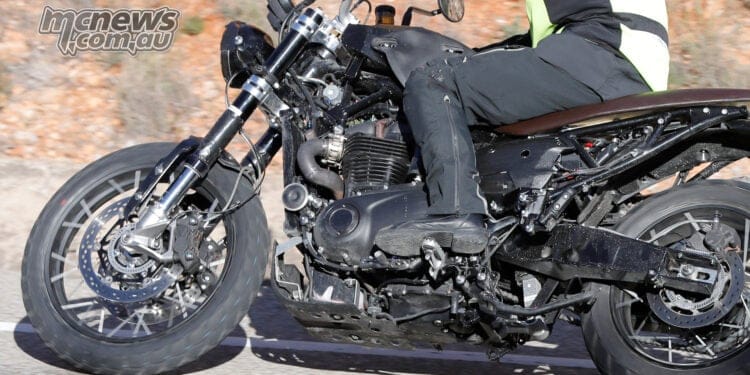
Triumph appears to be preparing the most significant chassis overhaul to its large-displacement modern classic range since the original 1200 platform launched in 2019. Development prototypes caught testing on tarmac in southern Europe reveal that Hinckley has quietly binned the signature twin outboard rear shock absorbers on the Triumph Scrambler 1200, replacing them with a fully concealed, linkage-operated monoshock tucked deep into the center of the frame.
Paired with a cast and fabricated box-section aluminum swingarm, a road-focused 19-inch wire-spoke front wheel, and a noticeably lower center of mass, this prototype signals a deliberate pivot. Triumph is moving its heavyweight scrambler away from tall desert-sled theater and re-engineering it into a sharpened European canyon carver that won’t punish your inseam at alpine hairpins.
The Mechanical Shift: Underslung Rocker Linkage Replaces Twin Shocks
The spy photographs confirm that Triumph has engineered an underslung progressive rocker linkage mounted beneath the swingarm pivot to actuate a single, centrally positioned monoshock. Where previous generations of the Triumph Scrambler 1200 relied on long-stroke dual rear shocks—either Öhlins piggyback units on the XE or Marzocchi dampers on the X—the new mule features a clean, unencumbered rear subframe without bulky upper damper mounts.
“A close look at the swingarm pivot on the Triumph prototype exposes a distinct silver rocker and linkage pull-rod mechanism slung underneath the main pivot axis. The shock body itself sits tucked inside the frame uprights, protected from road debris while centralizing mass directly behind the engine crankcases.”
This switch to a rising-rate linkage allows Hinckley’s chassis engineers to achieve supple initial compliance over sharp frost heaves without sacrificing bottoming resistance on hard compressions. The fabricated swingarm features reinforced webbing around the lower linkage mount, providing greater lateral stiffness under heavy cornering loads than the outgoing tubular twin-shock swingarm could ever deliver.
Wheel Sizing and Stance: A Road-Biased Chassis Geometry
The prototype rolls on a tubeless cross-spoke wheel combination featuring a 19-inch front hoop and a 17-inch rear, abandoning the towering 21-inch front wheel of the off-road-spec Scrambler 1200 XE. This front wheel sizing matches the road-biased geometry seen on the current Scrambler 1200 X, but the prototype sits noticeably lower to the ground with reduced fork overhang.
Up front, the test mule runs an inverted telehydraulic fork carrying dual radial-mount four-piston brake calipers clamping 310 mm floating discs. Despite the radical rear suspension makeover, the bike retains the unmistakable silhouette of Hinckley’s scrambler lineage: high-mounted twin side-pipe exhausts with brushed heat shields, a classic teardrop fuel tank, a round LED headlight with signature DRL, and wide tapered aluminum handlebars. The architecture closely parallels the chassis revisions seen when the Speed Twin 1200 was spied adopting a revised frame, hinting at a shared modular platform strategy across Triumph’s 1200cc twin family.
The Rider’s Trade-Off: Visual Heritage vs Dynamic Reality
Every motorcycle suspension redesign involves a compromise between nostalgic aesthetics and mechanical function. Dropping the twin outboard shocks strips away the pure 1960s desert sled visual language that sold thousands of modern classics to riders who fell in love with Steve McQueen imagery.
However, the functional payoff on real roads is massive. Outboard twin shocks suffer from lateral flex under high cornering loads, force the frame to bear suspension loads at the subframe junction, and add unsprung mass at the wheel axle. Moving to a rising-rate monoshock centralizes heavy damping mass, allows for a narrower rear waist, and dramatically improves high-speed damping control over broken asphalt. Much like how Triumph trimmed wheel diameter on the Tiger 1200 Rally to improve road manners, this monoshock scrambler gives up retro purism in exchange for handling dynamics that can actually keep up with modern middleweight scramblers like the Rieju Scrambler 607.
Technical Comparison: Monoshock Prototype vs Current Scrambler 1200 Family
| Specification | 2028 Monoshock Prototype (Est.) | Current Scrambler 1200 X | Current Scrambler 1200 XE |
|---|---|---|---|
| Engine Architecture | 1,200cc 270° Parallel Twin | 1,200cc 270° Parallel Twin | 1,200cc 270° Parallel Twin |
| Power Output | ~90 hp @ 7,250 rpm | 89 hp (66.2 kW) @ 7,000 rpm | 89 hp (66.2 kW) @ 7,000 rpm |
| Peak Torque | ~110 Nm @ 4,500 rpm | 110 Nm @ 4,250 rpm | 110 Nm @ 4,250 rpm |
| Rear Suspension | Concealed Monoshock with Underslung Linkage | Dual Marzocchi Piggyback Shocks | Dual Marzocchi / Öhlins Remote Shocks |
| Wheel Travel (F / R) | ~170 mm / 170 mm (est.) | 170 mm / 170 mm | 250 mm / 250 mm |
| Wheel Sizes (F / R) | 19-inch / 17-inch Tubeless Spoke | 19-inch / 17-inch Tubeless Spoke | 21-inch / 17-inch Tubeless Spoke |
| Seat Height | ~815 mm (est.) | 820 mm | 870 mm |
| European Base Price | ~€15,200 (est.) | €14,995 | €16,495 |
What We Know / What’s Still Unclear
What We Know: - Monoshock Chassis: The prototype runs a single rear shock actuated by an underslung linkage rocker below the swingarm, fully replacing the twin shocks. - Swingarm Overhaul: An all-new cast and fabricated box-section aluminum swingarm replaces the tubular unit of the current models. - 19-Inch Front Wheel: The test mule uses a road-biased 19-inch front wheel paired with dual radial front brake calipers. - High-Level Exhaust Retained: Hinckley’s signature right-side high-level dual exhaust routing remains intact with revised header routing.
What’s Still Unclear: - Model Lineup Role: It is not yet clear whether this monoshock variant will completely replace the Scrambler 1200 X or launch as a separate street-biased derivative alongside a twin-shock 1200 XE. - Engine Tuning: Whether the 1,200cc High Power Bonneville twin will receive internal cam and intake revisions to bump output past the current 90 hp threshold remains unconfirmed. - Showroom Arrival: Given the prototype’s advanced fabrication stage, an official unveiling is anticipated in late 2027 as a 2028 model.
Media citation: Editorial outlets and forums may quote excerpts with attribution and a link to Throttle Times.
Reporting via: mcnews.com.au, adbmag.com.au, cycleworld.com