AGV's New Pista GP R3 Helmet Rolls Instead of Snapping, Thanks to 1,600 Tiny Spheres
AGV's new race helmet rolls instead of snapping -- a 1,600-sphere layer that AGV says cuts concussion risk sixfold in an oblique hit.
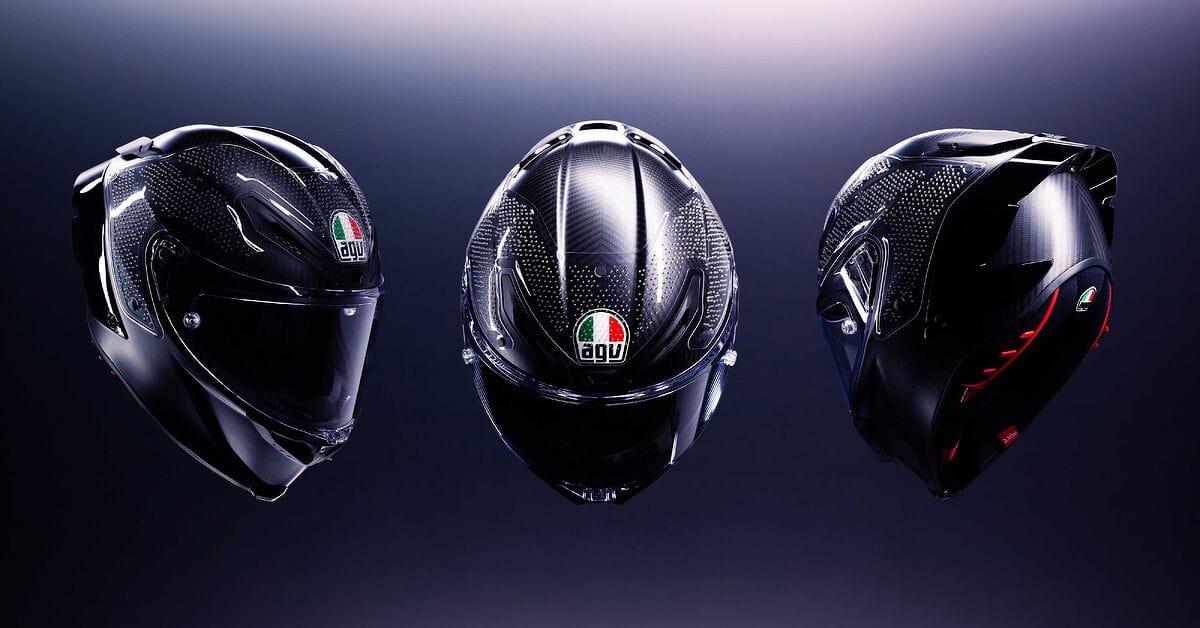
AGV just spent three years and 28,000 hours of R&D so that a MotoGP rider’s head can roll instead of snap sideways, and I’m somehow the guy getting excited about it from a garage where the most dangerous thing that happens is me forgetting to close the visor. The Pista GP R3 – AGV’s first real update to the Pista line since 2019 – debuted at the Misano round of MotoGP, and its headline feature is a genuinely new way of handling the hit nobody wants: the oblique one.
What Sphera actually is
Sphera is a matrix of more than 1,600 small plastic spheres, each 2mm across, bonded to the outer carbon-fibre shell and sandwiched under an additional polycarbonate layer. In an oblique impact, the spheres are designed to let the outer layer roll against the inner one, bleeding off the rotational force that causes concussion rather than transferring all of it straight into the rider’s head. AGV developed the system with London-based RLS (Release Layer System), refining technology that originated at Oxford University.
The numbers behind the claim
Testing at the Aragon Institute for Engineering Research at the University of Zaragoza found the Sphera panels reduce concussion risk by up to six times compared with a standard shell in the same impact. The panels sit on the forehead and either side of the visor mechanism, covering roughly 75% of where a front or side crash actually lands.
| Spec | Value |
|---|---|
| Sphere count | 1,600+ |
| Sphere diameter | 2mm |
| Concussion-risk reduction (lab test) | up to 6x |
| Impact-point coverage | ~75% (front/side) |
| Certification | FIM FRHPhe-02, ECE22.06 |
| Development time | ~3 years, 28,000+ hours |
| Weight | no heavier than the current Pista GP RR |
It’s not just the spheres
AGV also thickened the visor to up to 5mm in places for stronger retention force, added a rear spoiler with jagged cut-outs for high-speed aerodynamic stability, and reworked the comfort padding with patented ribbing on the cheek pads for noise reduction. None of that is the headline, but it’s the part that actually determines whether a rider tolerates wearing the thing for 45 minutes at 300 km/h.
Marco Bezzecchi, Valentino Rossi and Franco Morbidelli tested the helmet at Dainese’s Project Apex event on August 24 before it reached Misano – which is about as thorough a pre-launch stress test as a helmet gets, short of an actual crash. Bell’s Pit Boss half-helmet recall earlier this month is a reminder of how differently “impact protection” can turn out when nobody tests that hard first.
What’s still open
AGV hasn’t announced a release date or price for the Pista GP R3 – for now it’s race-only, worn by AGV’s MotoGP, Moto2 and Moto3 riders starting with San Marino. Race gear tends to trickle down to the rest of us eventually, on its own schedule – the same way Cardo’s free PACKTALK mesh update showed up long after the tech had already proven itself elsewhere.
FAQ
What is AGV’s Sphera technology?
A layer of over 1,600 small 2mm plastic spheres bonded between the Pista GP R3’s carbon shell and an inner polycarbonate layer, designed to roll during an oblique impact and reduce the rotational force that causes concussion.
How much safer does AGV claim the Pista GP R3 is?
Lab testing at the University of Zaragoza’s Aragon Institute for Engineering Research found up to a six-fold reduction in concussion risk compared with a standard shell.
When can you buy the AGV Pista GP R3?
AGV hasn’t announced a release date or price. It debuted as race-only equipment at the Misano MotoGP round in September 2026.
Which riders have worn the Pista GP R3?
Marco Bezzecchi, Valentino Rossi and Franco Morbidelli tested it at Dainese’s Project Apex event in August 2026, ahead of its Misano race debut.
Official product page: https://www.agv.com/us/en/agv-pista-gp-r3-motogp.html
Reporting via: motorcyclenews.com, motorcycle.com