Aprilia 850cc MotoGP Prototype Leaked: Savadori Tests Moustache Aero at Jerez
850cc & 75mm bore + Stepped moustache wings bypass 2027 front overhang limits + Aprilia beats Ducati to the punch with radical downforce aero.

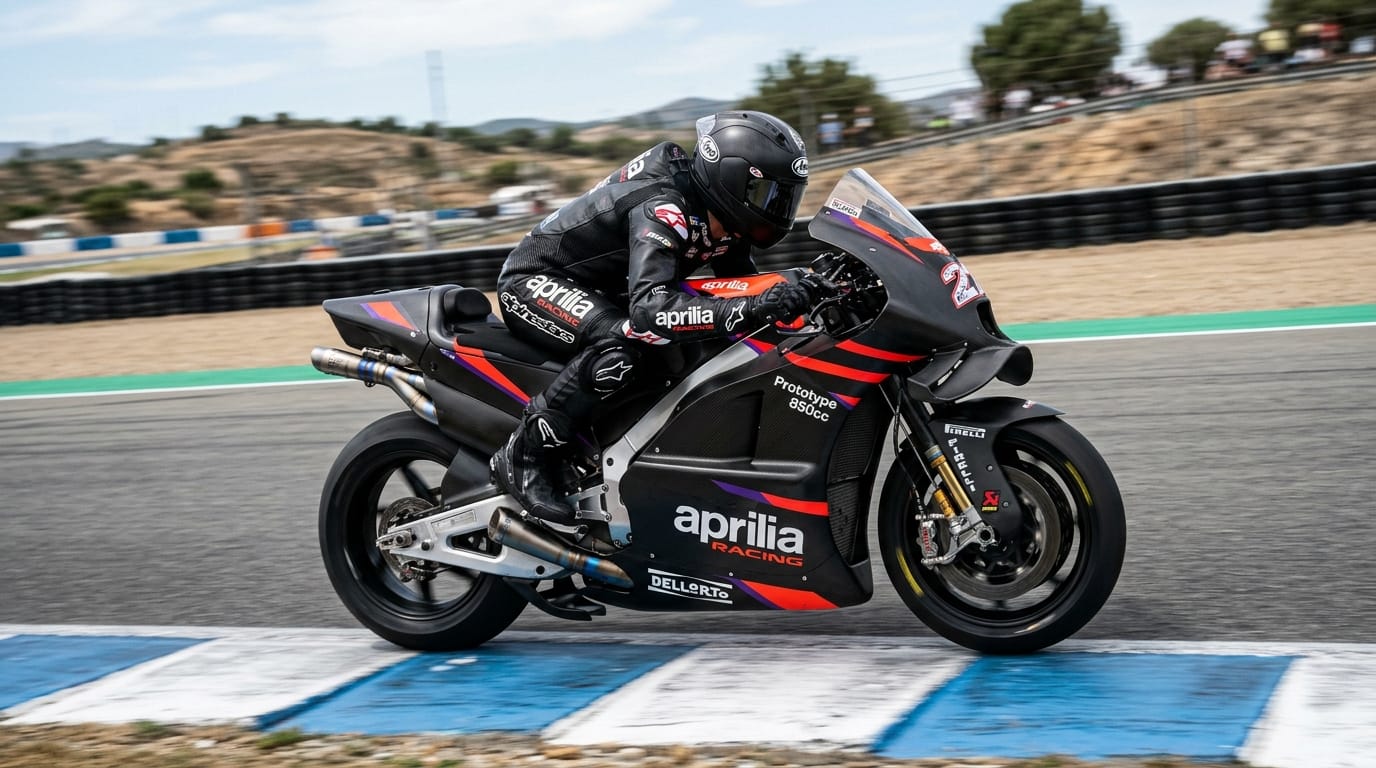
Aprilia has broken paddock silence on its 2027 technical architecture after official test rider Lorenzo Savadori published onboard footage and trackside photographs of the factory’s all-new 850cc RS-GP prototype lapping the Circuito de Jerez in Andalusia.
The leaked images reveal a radically reshaped carbon-fibre front fairing that incorporates a stepped “moustache” multi-plane winglet assembly, designed specifically to circumvent the upcoming 2027 FIM aerodynamic restrictions. With MotoGP mandating an engine displacement drop from 1,000cc to 850cc, a narrower front fairing width of 550mm (down from 600mm), and a strict ban on front appendages protruding forward of the front axle, Noale’s technical department—directed by former KTM and Ducati engineer Fabiano Sterlacchini—has produced the first physical proof that aero development will not slow down under the new rules.
Following hot on the heels of wet-weather shakedowns seen when 2027 MotoGP 850cc Prototypes Hit Jerez under KTM’s test crew, Aprilia’s leak marks the first uncamouflaged dry-track running of an Italian 850cc contender.
The Stepped Moustache Nose: Circumventing the 2027 Overhang Ban
The prototype’s primary visual departure is a complex, three-tier biplane wing system integrated into the lower snout of the fairing rather than mounted high on the nose cone. Under the 2027 technical regulations, all aerodynamic elements must sit within a reference box that restricts the front overhang by 50mm, effectively outlawing the protruding front shovel wings that currently dominate the grid.
Aprilia’s response is a cascading horizontal element that angles downward toward the mudguard, channeling high-pressure airflow directly beneath the triple clamps before venting through side ground-effect ducts. Rather than generating pure vertical downforce that induces high-speed aerodynamic drag on straightaways, the Jerez prototype employs vortex-shedding endplates to seal the air gap between the front tyre and the belly pan during maximum lean angles.
“We are working intensely on the transition to the 2027 rules, and our test program at Jerez gave us immediate correlation with the simulation numbers,” Savadori noted following the test session. “The engine character is completely different with the smaller cylinder bore, which means the entire chassis balance and aerodynamic load have to be re-engineered from a clean sheet.”
This aggressive ground-effect architecture builds on engineering principles seen when Piaggio Patents Active Aerodynamic Flaps across its sportbike division, showing how Noale intends to retain its corner-entry speed advantage.
850cc Downsizing: Bore Caps, Fuel Cuts, and 153 kg Mass
The 2027 engine formula fundamentally changes how a MotoGP prototype produces lap times. The new rules slash engine displacement by 150cc and reduce the maximum cylinder bore from 81mm to 75mm, immediately curbing the extreme over-square piston designs that allowed current 1,000cc engines to rev past 18,500 rpm.
To compensate for the loss of approximately 40 hp compared to the current 300+ hp 1,000cc beasts, Aprilia has rebuilt the RS-GP chassis around a significantly more compact V4 engine block. The fuel tank volume drops from 22 litres to 20 litres for Sunday Grands Prix (and 11 litres for Saturday sprints), allowing Sterlacchini’s chassis designers to draw the rider’s seating position 35mm closer to the headstock.
| Technical Parameter | 2026 Aprilia RS-GP (1,000cc) | 2027 Aprilia RS-GP Prototype (850cc) | Delta / Regulatory Change |
|---|---|---|---|
| Engine Displacement | 1,000cc V4 | 850cc V4 | -150cc (-15%) |
| Cylinder Bore Limit | 81.0mm | 75.0mm | -6.0mm maximum bore cap |
| Minimum Dry Weight | 157 kg | 153 kg | -4 kg reduction |
| Race Fuel Capacity | 22.0 Litres | 20.0 Litres | -2.0 Litres (-9.1%) |
| Fairing Width | 600mm max | 550mm max | -50mm narrower profile |
| Front Wing Overhang | Unrestricted forward box | 50mm rearward restriction | Eliminates shovel aero |
| Ride Height Devices | Front & rear shapers permitted | Banned completely | Mechanical suspension only |
The Rider’s Trade-Off: Mechanical Lean vs Electronic Crutches
The real sacrifice for factory riders transitioning to the 850cc generation is the total prohibition of ride-height devices (holeshot and shapers). For the past six seasons, Aprilia’s riders—proven when Bezzecchi Dominates Qatar GP to Hand Aprilia Historic First Lusail Win—have relied on hydraulic squat devices on corner exit to drop the bike’s centre of gravity and suppress wheelies.
Without shapers, the 850cc prototype must control wheelies purely through mechanical chassis geometry, swingarm pivot placement, and passive aero downforce. Savadori’s telemetry runs at Jerez revealed that while the 850cc bike changes direction noticeably quicker in the chicane transitions thanks to reduced engine crank inertia and a 153 kg dry weight, riders will face far greater rear-tyre wheelspin out of tight first-gear hairpins like Dry Sack.
What We Know
- Displacement & Layout: The prototype runs an 850cc 90-degree V4 engine adhering strictly to the 75mm bore limit.
- Aero Compliance: The stepped moustache nose winglets fit inside the reduced 550mm width and 50mm rearward packaging constraints.
- Test Platform: Lorenzo Savadori completed more than 140 laps over two days at Jerez focusing on base baseline maps and thermal tyre decay.
- Valencia Debut: A refined iteration of this chassis is scheduled to be handed to incoming factory riders for initial evaluation at the post-season test on December 1.
What’s Still Unclear
- GPS Telemetry Deficit: Aprilia has not released top-speed delta figures comparing the 850cc mule against the 2026 1,000cc bike down the 607m Jerez back straight.
- Pirelli Adaptation: The prototype ran on development Michelin rubber, leaving questions open about how the chassis geometry will respond when the spec tyre supplier switch occurs.
- Engine Valve Drive: Whether Aprilia is retaining pneumatic valve return or testing alternative cam profiles under the reduced bore ceiling remains closely guarded.
Media citation: Editorial outlets and forums may quote excerpts with attribution and a link to Throttle Times.
Reporting via: crash.net, gpblog.com