Shoei GT-Air 3 Smart Debuts at EICMA: 5,000-Nit Nano-OLED Visor HUD
5,000-nit Nano-OLED projection + Universal mesh comms + Shoei and EyeLights eliminate dashboard glances with a visor HUD that floats 3 meters ahead.

Part of Throttle Times’ live coverage of gear debuts at EICMA 2026.
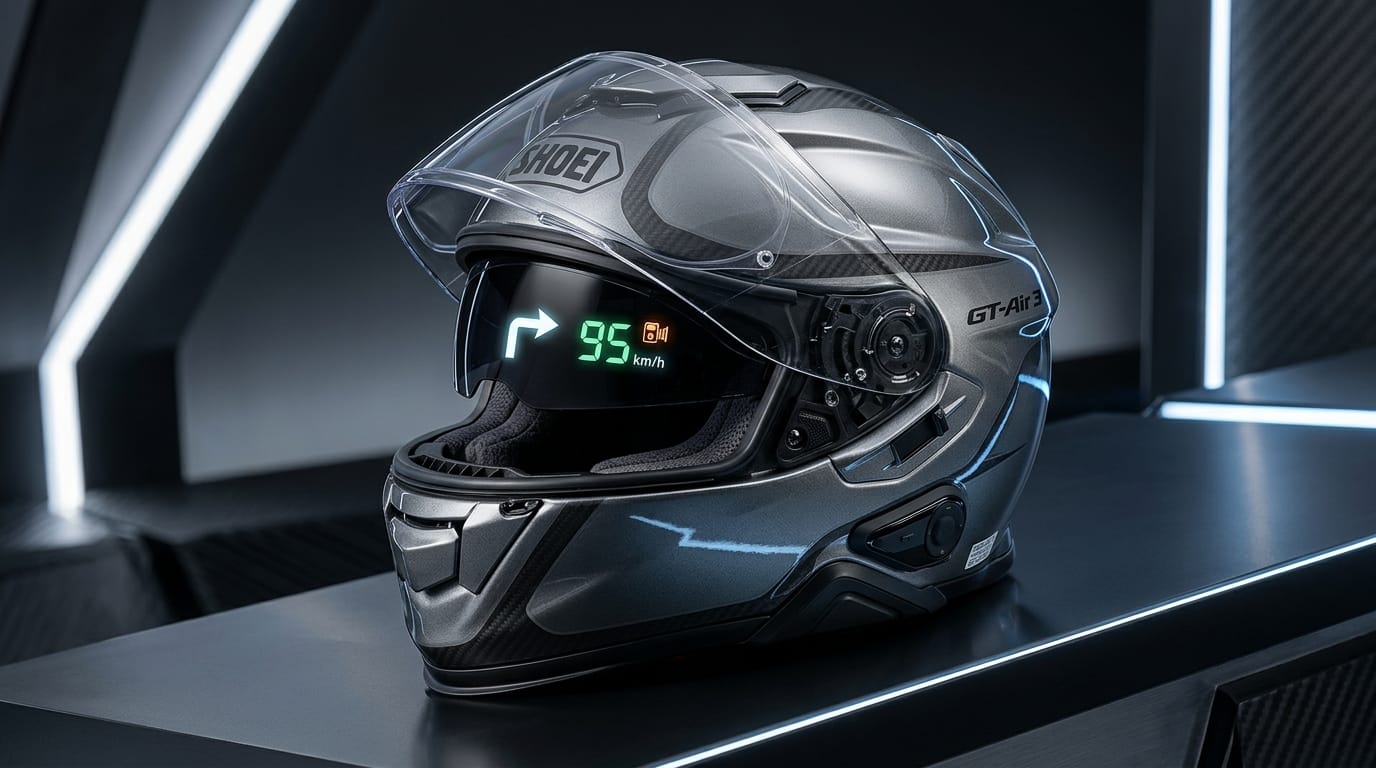
Shoei has teamed up with French augmented-reality specialist EyeLights to debut the GT-Air 3 Smart at EICMA 2026 in Milan, introducing the motorcycle industry’s first production touring helmet equipped with an integrated Nano-OLED Head-Up Display (HUD). Rather than relying on clunky aftermarket brackets or prism combiners that crowd the eye port, the system projects critical flight data—including turn-by-turn navigation arrows, vehicle speed, and speed camera warnings—directly onto the specially coated internal drop-down QSV-2 sunshield, creating a virtual floating image positioned roughly three meters into the rider’s forward view.
The release marks a significant milestone in connected rider safety, arriving alongside camera-integrated lids like the GoPro and AGV smart helmet and communicator-embedded helmets such as the Nolan X-804 ST Ultra Carbon.
Visor-Projected Nano-OLED Optics and EyeLights Hardware
The optical core of the Shoei GT-Air 3 Smart is an ultra-miniaturized Full HD Nano-OLED projection module built into the EPS liner above the brow line, generating an extraordinary 5,000 nits of peak brightness. This optical output ensures that navigational graphics and speed readouts remain crisp and readable even while riding directly into blinding low-winter Mediterranean sun or traversing reflective wet European asphalt.
Controlled via a low-profile handlebar remote and a dedicated iOS and Android application, the interface operates in three rider-selectable modes: Minimalist (speed, speed limit, and turn arrows), Commuter (traffic delay alerts and radar warnings), and Full Flight (lane assistance and upcoming fuel stop prompts).
“Every time a rider drops their chin to glance at a smartphone or TFT dashboard at 120 km/h, they travel 33 meters completely blind. Floating that critical data three meters ahead eliminates focal accommodation delay and keeps eyes locked onto hazards.” — EyeLights Optical Engineering Team, EICMA Launch Presentation
The helmet also integrates an all-in-one mesh communication system. Utilizing dual Bluetooth 5.3 and dynamic mesh protocols, the internal speakers and beamforming noise-cancelling microphones connect seamlessly with both Cardo Dynamic Mesh and Sena networks, solving the proprietary brand fragmentation that has plagued European touring groups for a decade.
The Rider’s Trade-Off: Visual Focus Versus Battery Dependency
The ergonomic benefit of the GT-Air 3 Smart is indisputable. Eliminating handlebar phone mounts cleans up the cockpit and completely prevents vibration damage to sensitive smartphone optical image stabilization sensors. In torrential rain or dark alpine tunnels, having turn arrows floating in your peripheral vision reduces mental fatigue substantially.
The compromise is electronics management and weight penalty. Housing the Nano-OLED projector, dual antennas, 40mm HD speakers, and a 2,200 mAh lithium battery pack adds approximately 145 grams to the helmet, pushing total curb mass to 1,795 grams in size Large. While battery life is rated at an honest 10 hours with the HUD active, forgetting to plug in the magnetic chin-curtain USB-C charge port overnight leaves you with a standard touring lid carrying dead optical weight. European pricing is confirmed at €1,099, representing a €450 premium over a standard GT-Air 3.
Aerodynamics and Impact Safety Compliance
Shoei engineered the helmet shell from its proprietary AIM (Advanced Integrated Matrix) multi-composite fiber blend, ensuring full ECE 22.06 type approval without sacrificing shell integrity. The internal EPS liner features precision-machined cutouts that house the projector and wiring without reducing the impact-absorption foam density in critical frontal and temporal zones.
Aerodynamics retain the integrated rear spoiler and vortex generators found on the standard GT-Air 3, which limit buffeting and wind roar to a measured 84 dB(A) at 100 km/h behind a standard touring screen. While innovative designs like the ROOF DJAGGER rear-opening helmet rethink entry mechanics, Shoei’s execution focuses squarely on digital optical integration.
Technical Comparison: Smart Touring Helmets
| Specification | Shoei GT-Air 3 Smart | Base Shoei GT-Air 3 | AGV Tourmodular (with Sena) |
|---|---|---|---|
| Shell Material | AIM Multi-Composite | AIM Multi-Composite | Carbon-Aramid-Fiberglass |
| Display Tech | 5,000-nit Nano-OLED HUD | None | None |
| Projection Surface | QSV-2 Coated Sunshield | QSV-2 Drop-down shield | Drop-down sunshield |
| Safety Standard | ECE 22.06 certified | ECE 22.06 certified | ECE 22.06 / P/J certified |
| Comms Compatibility | Native Universal Mesh | SRL3 optional cut-out | Insale Cardo DMC / Sena |
| Battery Life | 10 hours continuous HUD | N/A | 13 hours talk time |
| Total Weight (L) | 1,795 grams | 1,650 grams | 1,720 grams |
| European Price | €1,099 | €649 | €899 (bundled) |
What We Know / What’s Still Unclear
What We Know: - World’s first production helmet with fully integrated Nano-OLED Head-Up Display certified under ECE 22.06. - 5,000-nit brightness projection on QSV-2 sunshield provides virtual 3-meter focal depth. - Universal mesh intercom connects with both Cardo and Sena riders out of the box. - Handlebar wireless remote control and magnetic USB-C fast charging included.
What’s Still Unclear: - European dealership delivery is scheduled for March 2027, but country-specific launch allocations have not been finalized. - Replacement cost for HUD-coated replacement sun visors has not yet been listed in Shoei’s spare parts catalog.
Media citation: Editorial outlets and forums may quote excerpts with attribution and a link to Throttle Times.
Official product page: https://www.shoei-europe.com/products/gt-air-3-smart/
Reporting via: eye-lights.com, motor.nl