A1, A2, and A: How the EU's Motorcycle Licence System Actually Works
A1 gets you 125cc and 11kW at 16. A2 gets you 35kW at 18. Full A opens everything, at 24 or two years later. Here's the whole EU ladder, with the real bikes sitting on each rung.
The EU splits motorcycle licences into three tiers — A1, A2, and A — based on age and power, not engine size alone. A1 covers up to 125cc and 11kW from age 16, A2 covers up to 35kW from age 18, and full A opens every bike on the market, either directly at 24 or two years after A2 at age 20. Here’s how the whole ladder actually works, and which real, currently-on-sale bikes sit at each rung.
The three licences at a glance
| Licence | Engine/power limit | Power-to-weight | Minimum age (direct) | Minimum age (progressive) |
|---|---|---|---|---|
| A1 | ≤125cc, <11kW (14.75hp) | ≤0.1 kW/kg | 16 | — |
| A2 | ≤35kW (47hp) | ≤0.2 kW/kg | 18 | — |
| A | No limit | No limit | 24 | 20 (after 2 years on A2) |
These figures come straight from EU Directive 2006/126/EC, the framework every member state’s national licence law is built on. It’s the floor, not a ceiling — a handful of countries set their own minimum ages a year or so above it, so check your national transport authority before booking a test, especially if you’re right at the boundary.
There’s a fourth category worth a one-line mention even though it’s not what this piece is about: AM, for mopeds and light quads up to 50cc/45km/h, with a minimum age that’s usually 16 but drops to 14 in some countries. If you’ve ever wondered why your little cousin is legally allowed to buzz around on a Vespa before you were allowed to drive anything, that’s why.
A1: what a 16-year-old can actually ride
A1 lets a 16-year-old ride anything up to 125cc and under 11kW, with a power-to-weight ratio capped at 0.1 kW/kg — so a featherweight 125 with a slightly punchier engine still has to stay under that ratio, not just the raw kW figure. In practice this is the commuter tier: small-capacity nakeds, scramblers, and dual-sports built specifically to sit at or just under the 11kW line, because nobody’s selling a 125 with headroom to spare in a segment this price-sensitive.
I did my own A1 year on a bike I’m not going to name because I’ve made fun of it too many times already, and I still think it’s the most honest riding education there is — you learn to carry corner speed because you genuinely don’t have the power to fix a bad line with the throttle.
A2: the licence that actually shapes Europe’s showrooms
A2 is where the real market is. 18 years old, up to 35kW (47hp), power-to-weight capped at 0.2 kW/kg — and because so much of Europe’s middleweight lineup is built to land exactly on that number, A2 has become less a “learner” tier and more the default licence a huge chunk of adult riders just… stay on for years.
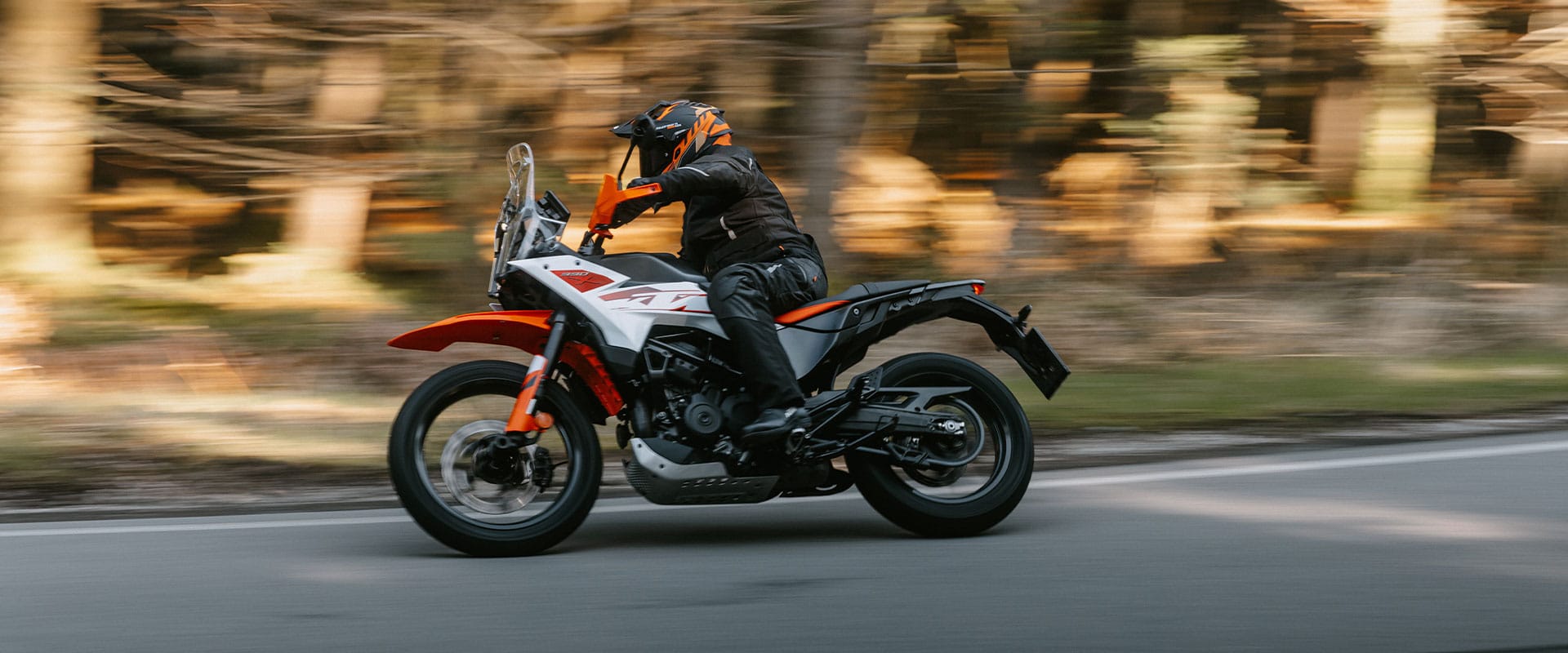
Some bikes hit the A2 ceiling naturally. KTM’s 390 Adventure makes 32kW from its 373cc single — no restriction plate, no derated ECU, it’s simply built to the number. Others are full-fat bikes with an A2 mode bolted on: CFMoto’s 800MT-ES makes roughly 69kW (92bhp) in its unrestricted form and gets throttled down to the same 35kW for A2 riders, electronic suspension and all. Kove’s baby 450 Rally, still only known from patent filings, is being built from scratch as an A2-legal machine rather than a detuned bigger bike. Even Bajaj’s first adventure bike, spotted testing with KTM-derived hardware, is aimed squarely at this bracket. If you want a sense of how much of the current new-bike conversation in Europe is really an A2 conversation, go look at how many of the Chinese brands worth taking seriously right now built their whole opening lineup around this exact power figure.
The “double power” rule that keeps A2 from being a loophole
Here’s the part people get wrong most often: you can’t just take any bike, restrict it to 35kW, and call it A2-legal. The rule is that a restricted bike’s unrestricted output can’t exceed double the A2 limit — 70kW. That’s why CFMoto can offer an A2 version of the 800MT-ES (69kW unrestricted, just under the line) but a manufacturer can’t do the same trick with a 100kW+ superbike. It’s also why “A2-legal” and “A2-restricted” aren’t quite the same phrase — a bike can be A2-legal by simply not making more than 35kW in the first place, with nothing to restrict at all.
The mechanical restriction itself usually means a different ECU map, a smaller throttle body insert, or an airbox restrictor, and reputable dealers apply it as an approved, reversible kit rather than a permanent detuning — which matters, because the day you upgrade to a full A licence, you generally want that power back without buying a new bike.
Getting to A: direct access at 24, or two years of patience at 20
Full category A removes every limit, but there are two ways in. Direct access requires you to be 24 and pass the test on an unrestricted bike — no A2 time served at all. Progressive access lets you get there at 20, provided you’ve already held A2 for a minimum of two years; some countries additionally require a short theory or practical top-up course rather than a straight swap.
This is the point where riders finally get to the bikes with no ceiling at all — the ones this site spends most of its time drooling over, like BMW’s next-generation S1000RR, or whatever KTM ends up doing with the RC 790 its CEO just confirmed. I spent my own two years on A2 mostly pricing bikes I couldn’t yet legally own, which turns out to be a fairly common way to pass the time.
What the EU floor doesn’t cover
A few things this framework deliberately leaves to national governments, so “the EU rule” isn’t always the whole story:
- Higher local minimum ages. The 16/18/20/24 ladder is the EU minimum; a member state can and occasionally does set its own bar a notch higher.
- Licence category swaps between countries. An A2 licence issued in one member state is valid EU-wide, but the paperwork for topping it up to full A can vary in how it’s processed locally.
- Helmet, gear, and passenger rules. These sit under separate national road-traffic law, not the driving-licence directive, so what’s mandatory in one country (reflective vests, specific helmet certification) isn’t universal.
- Insurance loadings for new licence holders. Nothing to do with the EU directive at all, but worth knowing before you budget for that first A2 bike — new-rider premiums bite everywhere.
What’s changing in 2029
The EU adopted a revised Driving Licence Directive that entered into force on 25 November 2025, with member states applying it from 26 November 2029. The good news for anyone reading this to plan a licence: it keeps the AM/A1/A2/A category structure and the power figures above completely intact — no rewrite of the numbers this article is built on. The changes that do land are mostly administrative: motorcycle and car licences move to a 15-year validity period (10 years if the licence doubles as an ID document), and the directive tidies up how licences issued in one member state are recognised and exchanged in another. Worth knowing about, not worth waiting for.
FAQ
What’s the difference between A1, A2, and A licences in the EU?
A1 covers motorcycles up to 125cc and 11kW from age 16. A2 covers up to 35kW from age 18. Full A removes all power limits and opens at 24 directly, or at 20 after two years on an A2 licence.
Can I ride a big, powerful motorcycle if it’s electronically restricted to 35kW?
Only if its unrestricted power output doesn’t exceed 70kW — double the A2 limit. A 92bhp (roughly 69kW) bike like CFMoto’s 800MT-ES qualifies for an A2-restricted version; a 130kW superbike doesn’t.
Do I have to wait two years to upgrade from A2 to a full A licence?
Not necessarily. Progressive access lets you upgrade at 20 after two years on A2. If you’re 24 or older, you can take the full A test directly without ever holding an A2 licence.
Is the EU licence system about to change?
The categories and power limits aren’t changing. The EU’s revised Driving Licence Directive, in force since November 2025 and applying from November 2029, mainly changes licence validity periods and cross-border recognition — the A1/A2/A structure stays as described here.
Are these age and power limits the same in every EU country?
The figures above are the EU-wide floor set by Directive 2006/126/EC. A member state can set its own minimum age a year or so higher, so it’s worth a quick check with your national transport authority if you’re right on a boundary.